Tag: life coach (Page 9 of 17)

Separation and Divorce

Both separation and divorce are difficult experiences.  This can be particularly true when dealing with a toxic person.  Narcissists are often the main cause of many relationship breakdowns, although you’d never hear them taking ownership of their part in it.  And they can make it more challenging when children are involved.

We may find ourselves questioning how we ended up with a narcissist or other toxic person in the first place.  In some cases, if we have toxic role models in our lives, they have likely taught us a very skewed version of love.  In actuality, it isn’t love, but as children, we have no way of knowing that.  If we call a spade a spade, it’s control, manipulation, and abuse masquerading as what we’re expected to accept as “love”.  For others, it may be that we grew up in a loving, functional, and healthy family but we meet a person who does a good job of pretending to be someone they’re not, until they get us where they want us.  That place may be marriage, shared debt, children, or a multitude of other things that bind us to them and make it harder for us to walk away.

Regardless of how we’ve ended up with toxic people, if we eventually find our way to the point of leaving, we can use all the support we can get.  Unfortunately, when our family of origin is dysfunctional, we’re unlikely to receive any authentic support from them.  In fact, they may even make the whole situation feel even worse.  For many, it’s also common to have feelings of embarrassment or shame coming into the picture, so they don’t want to turn to anyone, even healthy family and friends.

If you’re going through separation or divorce, or in the phases leading to it, reach out for support.  When you are fortunate to have loving people in your life, consider talking to them about your situation.  You might be surprised just how much it can help to have people behind you who understand what you’re going through.  And, honestly, there’s no shame or reason to be embarrassed about leaving an unhealthy relationship.  We all have our limits, and only we can decide when it’s time to close a chapter in our lives.  But we don’t need to be martyrs and hang on, especially if it’s to avoid judgment by others.  Let people judge.  That’s their problem, not ours.

And when we don’t have anyone we feel we can to turn to on a personal level, it may be time to seek out other resources.   This could be online or in-person support groups, counselling or coaching, or reading or watching videos about the various parts of relationship breakdown and how to cope.  As a side note, find legal resources to protect yourself on that front as well.  If you can’t afford a lawyer, search for resources that can be of assistance.  Find that light at the end of the tunnel.  Trust me, it’s there.

With coaching, there is someone available to hear you, to help guide you towards a new chapter with courage andempowerment, and to assist you in taking a deep dive into what you want your future to look like, no matter where you’re at in life.  Check in with this website often, as there will be new online programs being released in the upcoming months that you might find helpful.

Just know, it does get better.  We grow through what we go through.  Even though these situations can make us feel weak and lost, we typically come out of them feeling stronger and more focused.

Until next time,

Heather ~Natural Clarity Coaching~ naturalclaritycoaching.com na********************@***il.com Natural Clarity Coaching on Facebook, Instagram, LinkedIn, and Twitter

New Online Program Being Created

Hi All,

Hope this finds you well.  Thanks to everyone who has recently joined the mailing list and to the increasing numbers of people who are touching down on the website.

Just letting you know that I’m working on a new program to be offered online.  I’ll post an announcement once it’s up and running.  I think it will be a beneficial program, and I’m looking forward to launching it in the next few months.

Until next time,

Heather ~Natural Clarity Coaching~ naturalclaritycoaching.com na********************@***il.com Natural Clarity Coaching on Facebook, Instagram, LinkedIn, and Twitter
 

Accepting Yourself

Toxic people often try to make others feel “less than”.  Why?  Because it makes them feel superior.  It gives them someone to criticize and point fingers at.  It protects their fragile egos.

At the heart of what we need in order to be immune from the tactics of toxic people is acceptance.  Acceptance of ourselves.  When we accept ourselves – positives, flaws, all of who we are –  we empower ourselves.  If we’ve accepted (and maybe even embraced) who we are, then what others say is less likely to have a negative impact on us.  Narcissists, flying monkeys, enablers…none of them will affect us on that level.  We know who we are and that’s that.

Learning acceptance of oneself can seem like a daunting task at first.  But it gets easier the more we engage in it.  In an upcoming post will be some suggestions for seeking out and putting into practice acceptance skills.  There’s no one-size-fits-all approach because each of us is unique.  But it’s possible to find what we need and make it a way of life.  More in the next post.

Until next time,

Heather ~Natural Clarity Coaching~ naturalclaritycoaching.com na********************@***il.com Natural Clarity Coaching on Facebook, Instagram, LinkedIn, and Twitter

Scapegoats of Narcissists: Abused and then taking the blame for the abuse

A key feature of narcissists is their need to create a scapegoat (or, sometimes, scapegoats).  Scapegoats are the fall guys for toxic people.  Narcissists: “Our family has problems…the scapegoat caused all of it”…”I’m having a bad day at the office…the scapegoat is at fault”.  Obviously they wouldn’t use the term “scapegoat”.  Replace that with actual names and you’ve got it.

Anyone who is a scapegoat will have experienced narcissistic abuse (put-downs, endless criticisms, regular pointing out of alleged flaws, being unjustifiably blamed for everything, sometimes physical abuse, and so on).  This can occur anywhere – within families, romantic relationships, or within workplaces.  And its purpose is to keep the heat off the narcissist.  They pass the buck so that they never need to be accountable for their actions or viewed as they truly are.  So, this abuse is the first step within a toxic system.  The second step is that of scapegoats accepting blame for the abuse.  Most scapegoats find themselves feeling so defeated and downtrodden that they begin to believe that they are who they’re told they are, everything wrong is their fault, and they deserve to be abused.  We’re trained to believe these things; that we’re the problem and we get the treatment that is coming to us as a result.  That’s what the narcissist needs us to believe, and they often have enablers/flying monkeys who will gladly support this dysfunctional system just to maintain the status quo and to avoid becoming abused or scapegoated themselves.

It’s quite the grand cover-up that narcissists create for themselves at the expense of others.  So, when it looks like they have everything locked up and have left us no way out, how do we escape it?  The biggest step is awareness.  Just being conscious of how this disordered system works is more than half the battle.  Beyond that, we have numerous options.  We can go low- or no-contact with the abusive individual and their enablers.  This can be challenging, whether it’s within a workplace, family, or other type of relationship.  It may mean taking steps that are outside of our comfort zone.  But we are never trapped unless we allow ourselves to believe that we are.  There are paths out of the lair.  We just need to see them and be willing to take the steps.  That may mean walking away from or creating strong boundaries within family or relationships, asking for shift or department changes at work, or maybe even finding a new job with a healthy environment.


No one…absolutely no one…deserves to be abused, let alone trained to feel that they brought the abuse on themselves.  It’s soul-crushing and unfair.  Once we see the actual truth of how it all works, we can open our minds to new, healthy possibilities for ourselves.  For me, personally, when I pulled myself out of the narcissistic and abusive system and began to heal, my life started to change in amazing ways.  I also learned so much about who I am.  Read that again:  who I am.  Because it’s difficult to know who we truly are within abuse.  It becomes much clearer when we’re no longer being manipulated and abused.  The basic fact, though, is that none of us are the person that dysfunctional people and their enablers make us out to be.  That’s just a fictional role that is thrust upon us to serve the selfish needs of others.  We don’t have to wear the scapegoat suit, nor do we have to accept abuse at the hands of anyone.  We aren’t responsible for making anyone feel good about themselves or holding together a dysfunctional system that thrives on toxicity, just to avoid rocking the boat.  Rocking the boat needs to happen if positive change is to come into our lives.

And there are always people available to help us along the way.  They can come in the form of non-toxic family members, friends, co-workers.  There are also many different professionals who can help, including life coaches, counsellors, social workers, HR representatives in workplaces, and the list goes on.  We aren’t ever alone, even though it may sometimes feel that way.

Until next time,

Heather ~Natural Clarity Coaching~ naturalclaritycoaching.com na********************@***il.com Natural Clarity Coaching on Facebook, Instagram, LinkedIn, and Twitter

Happy Holidays! Here’s some tips to help you get through, especially if toxic people are in the picture

Well, here we go.  Another holiday season is upon us.  While special occasions should be enjoyable, they can be quite the opposite when toxic people are involved.  Be they partners, family, friends, coworkers, etc., some people seem to drag their drama and unpleasantries to every party, gathering, and dinner table when the holidays come around.

As I’ve mentioned in previous posts, if we need/want to attend events that will include narcissists and other difficult people, boundaries are always at our disposal.  That could include avoiding conversations, speaking minimally if we get pulled into any chit-chat, or walking away if we feel the need to do so.  It’s possible to be polite and not make a scene when attempting to avoid contact with someone.  Unless we’d like to make a scene, of course.  In that case, go for it!  Just be true to you, whatever that may look like.  And even if we’re in a room full of enablers (flying monkeys) of the toxic person/people, we can hold our heads high while recognizing that narcissists are very convincing, manipulative people who can pull the wool over some people’s eyes.  But that often changes.  Until then, we can define it as one of those “it is what it is” situations.  In the end, the behaviour of toxic people and their dutiful flying monkeys has absolutely nothing to do with us.  We just happen to be the (often scapegoated) current target of their misery and drama.

We can also choose not to attend events at which the person or people in question may be.  Yes, it sucks to miss out but we need to weigh that against loss of peace and increases in stress levels.

For those of us who are low- or no-contact and have been choosing not to attend events with certain individuals, the little worm of loneliness may try to creep in.  But we can ignore that feeling by keeping ourselves busy with new traditions, hobbies, or making plans for spending time with people who are less challenging to be around.

And above all else, make time for self-care.  Even five minutes can help if that’s all the time we can manage.  Deep breathing, yoga, going for a walk, time with friends, a warm bath…whatever gives us some downtime and relaxation can make a world of difference.  Absolutely every little moment of self-care helps our bodies, minds, and spirits to stay resilient and provides optimal chances for overall wellbeing.

Happy Holidays!  We can do this! 

Until next time,

Heather ~Natural Clarity Coaching~ naturalclaritycoaching.com na********************@***il.com Natural Clarity Coaching on Facebook, Instagram, LinkedIn, and Twitter

Narcissists love fanning the flames of discord, especially against scapegoats

For anyone who has had issues with a narcissist or other toxic individual, it is evident that they love to fan the flames of discord. Oh, they’ll smile and try to hide the bellows behind their back, but they’re definitely keeping that fire nice and hot when no one is looking.

When a narcissist chooses a scapegoat (or sometimes more than one), within a family, workplace, or other environment, they then need to continue the narrative against that person at all costs. Without the continuation of this false narrative they have created against their target(s), the entire system upon which they bolster their fragile ego, is at risk of collapsing. This is especially true when they feel that their control is being threatened. Some examples of this may be an enabling parent showing kindness or some other form of positivity towards a scapegoated child, or it could be a scapegoated individual in the workplace who is having a friendly chat with a “flying monkey” co-worker in the lunchroom. Narcissists in particular can’t allow those types of things to happen because it goes against the picture they’ve painted of their target, and they also don’t want to risk people having a discussion about them and discovering the truth.

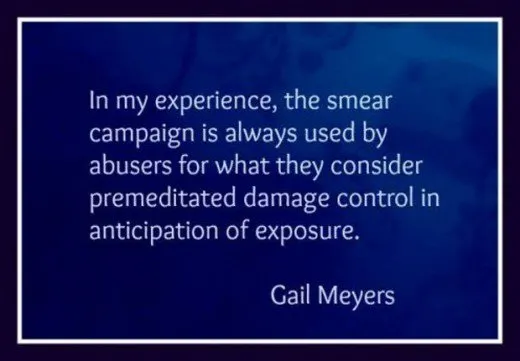
When toxic people feel threatened, they react with more manipulation and aggression. Basically, they start what is known as a smear campaign. They call their enablers to action through more lies, negativity, and exaggerations about their targets. They ramp up their alleged role of victim in their twisted game where they are, in fact, anything but victims. And their enablers naively jump to their defence and (in their minds) heroically rescue them from such horrible behaviour. Most of the time, enablers and flying monkeys don’t even attempt to hear anyone else’s side of the story. They flat out believe the nonsense they’re being fed. In my experience, some enablers will also return to scapegoating the narcissist’s target simply to bring an end to the ranting and raging. What they truly believe is anyone’s guess; their goal is simply to find a (usually temporary) reprieve from the toxic person’s thunderstorm. Overall, though, toxic people will pull out all the stops in an effort to maintain their control and position within their environment. Those false narratives are the very foundation of the protection of their egos. If they couldn’t triangulate and place blame on others, then they might ultimately be asked by their enablers to face accountability or, even worse, be forced to honestly evaluate themselves and engage in introspection. To a narcissist or other toxic individual, that would be a fate worse than death.

So if we’re the scapegoat and we recognize, based on the behaviour of others, that the narcissist/toxic person in our life has been frantically pumping those bellows and turning up the heat against us, even though we’re typically left in the dark as to what has been said, what can we do? Well, that varies by individual. One method that people find useful is to not JADE; that is, don’t Justify, Argue, Defend, or Explain. Yes, that’s a challenging task. No one wants to have lies floating around about them, and it’s human nature to want to JADE. But another more viable option is to simply live our lives and let our behaviour speak for itself. And in all honesty, silence speaks volumes, people. It truly does. There will always be enablers and flying monkeys. That’s just a fact of life. It lies with us to decide how much we will allow those dynamics to create negative personal impacts for us. Yet another option is to learn to let go of or distance ourselves from people who don’t see us as we truly are, but, rather, choose to believe the tales being spun about us by toxic people who are all about being in control and actively working to destroy relationships that they feel threatened by. Even though it’s easy to feel trapped within toxic systems, and we’ve often been trained to feel that we’re permanently stuck, helpless, and lacking any control over our own lives, we do have choices as to how we react to toxicity and dysfunction being aimed at us. We truly do have power. Remembering that fact and feeling empowered by it is half the battle.

Until next time,

Heather ~Natural Clarity Coaching~ naturalclaritycoaching.com na********************@***il.com Natural Clarity Coaching on Facebook, Instagram, LinkedIn, and Twitter

The hypocrisy of toxic and personality-disordered individuals

“Do as I say, not as I do”. This is a mainstay of toxic people, particularly narcissists. Most adult children of narcissists will likely have plenty of experience with this occurrence. For example, I grew up being force-fed the virtues of always being honest to a fault, to the point where I became a nervous wreck that I might some day be misunderstood by someone and accused of being dishonest. It used to feel as though the core of who I was would melt away if that ever happened. And that was because of the extreme pressure and scrutiny I was placed under to ensure that I carefully considered each and every single word I ever uttered. Ironically, the very “holier-than-thou” person who relentlessly pushed honesty on me and pretended to tell the truth at all costs, turned out to be incredibly dishonest. I just didn’t realize it when I was younger because they touted themselves as a pinnacle of all things truthful, and questioning or disbelief never failed to bring with them harsh consequences for me.

Definition Of A Hypocrite

So how do we uncover hypocrites? If something feels not quite right…if your intuition is chattering at you…if you’re catching someone in inconsistencies between their expectations of the world around them, while engaging in behaviour themselves that they have made clear that they don’t condone – question it. Literally, question it. You don’t necessarily have to confront the person immediately or at all, but, instead, you can run through everything logically in your mind, journal it, or talk with a trusted friend or family member about it. Leave out any ideals you have about the individual. Put aside emotion. Just look at the facts. And if they don’t add up, proceed with caution when it comes to your relationship with them. As the saying goes, “when someone shows you who they are, believe them”. Don’t make excuses for them, and take it as a serious warning. If the evidence amounts to someone who can’t be trusted to live their own life at the same level they seem to expect and, often, demand from others, then keep that in mind in future interactions with this person. Why? Because the likelihood of being damaged by someone who displays hypocritical behaviour is quite high. And we all have the right to protect ourselves from harm of any kind.

Until next time,

Heather ~Natural Clarity Coaching~ naturalclaritycoaching.com na********************@***il.com Natural Clarity Coaching on Facebook, Instagram, LinkedIn, and Twitter

It’s YOUR Life

As a member of many online groups on the subject of dealing with narcissists and other toxic individuals, I have observed a variety of common themes within posts. A main current is that of one’s life not feeling like their own. This typically takes the shape of people being almost constantly bombarded with opinions, criticisms, and unsolicited advice about how they should be living their lives, particularly as adults. And, taking it one step further, if the individual doesn’t conform to the opinions, criticisms, and unsolicited advice of these people (narcissistic parents, partners, friends, colleagues, etc.), they will be faced with some form of punishment such as the silent treatment or abandonment, guilt-tripping, a smear campaign, or some other manipulative treatment meant to cause someone to “do as they’re told”.

What we need to keep in mind is that this is OUR life. No one else has the right to tell us how to live it, nor do we owe anyone explanations for our decisions. If someone feels that it’s acceptable to dole out punishment because we have not followed their advice on something within our own life, that’s very telling of their character and not ours. And we have no obligation whatsoever to anyone but ourselves when it comes to our life decisions. Going forward, we may also need to evaluate our relationships with those who feel that they are justified in telling us how to live and then trying to manipulate and control us into doing what they want. There are ways (such as low or no contact, placing boundaries, etc.) to protect ourselves from that type of behaviour.

If we follow our hearts and dreams, trust ourselves as captains of our own ships, and steer clear of other people’s unsolicited interference in our decision-making (very different situation from those times we may approach a trusted individual for advice), we will be fine. And, in all honesty, we all make mistakes. We’re human. As long as we learn from those mistakes, that’s all part and parcel of a growth mindset. It makes us stronger, gives us greater knowledge and experience, and empowers us as we journey through life. No one is intended to have others run their life for them. Nor should we feel guilty or wrong if we make our own decisions. We need to take our own path, believe in ourselves, and not be held back by anyone or anything. So, get out there and live life to its fullest and on your own terms.

Until next time,

Heather ~Natural Clarity Coaching~ naturalclaritycoaching.com na********************@***il.com Natural Clarity Coaching on Facebook, Instagram, LinkedIn, and Twitter

They make it about you because it can’t be about them

It’s intriguing how narcissistically-inclined individuals refuse to take the blame for anything, even when everyone involved is aware that they are clearly at fault. Definitely a case of ego protection. Fragile egos cannot withstand being wrong…ever. And one of the best add-ons to refusing to take the blame is often putting that blame onto others.

Using family as an example, if we happen to be the scapegoat, that makes us the ongoing target of narcissists or other toxic people who need to shift the direction in which fingers are pointing. Plus, it’s easy for a dysfunctional family to accept without question that the designated scapegoat is the problem, even without any evidence or so much as asking for their perspective on the matter at hand. This could also happen in the workplace, social situations, or other environments.

So the next time that you are blamed for something you didn’t do, say, or whatever the accusation entails, consider the source. Is this someone with a fragile ego? Have you thought of them being narcissistic in nature? Do they have to be ‘right’ at all costs in order to continue their mask of perfection? Have they dragged you into it as a scapegoat for their own behaviour? Or is this person a flying monkey, acting on behalf of a narcissist who’s trying to shift blame? If so, stay strong. Take the emotion out and consider the mechanics of it. When you look at the situation from a neutral state, it’s much less complicated to approach. Avoiding JADE-ing – Justify, Argue, Defend, Explain – will also be useful. None of that is necessary. Walk away if you can. Say as little as possible. Don’t engage with the blame projector or anyone who is encouraging or furthering their accusations. Hold your head high. People (particularly flying monkeys) will believe what they want to believe, no matter what we say or do. Know that this has nothing to do with you and you owe no one any explanations or apologies. If you absolutely need to speak for yourself, stick to the facts and leave that emotional component out of it.

And remember, they make it about you because they literally aren’t strong enough for it to be about them. They can’t be wrong. They refuse to be accountable as a result. This is a disordered person and, usually, their merry band of enablers on the sidelines. No amount of explaining, putting forward evidence, or pointing the finger will improve the situation. Narcissists and assorted other toxic people will not back down, especially if it involves their egos taking a hit. It helps to focus on being grateful that you don’t need to live your life like that. Think about how much energy is required to behave in that fashion and continually find ways to protect against any hits to the ego. Leave them to their devices and move forward. It isn’t easy to be blamed for other people’s actions. But accepting the blame is an entirely different aspect. Just because someone says it, doesn’t make it true, nor does it mean we need to accept it. Know yourself and stay loyal to who you are, regardless of whatever chaos may be swirling around.

Trust me when I say that the more you practice leaving the emotion out of interactions with narcissists or their supporters, the easier it gets to stay calm and not be affected by their behaviour. This leads to improved awareness and empowerment, which allows us the tools to avoid being trapped in the future webs of narcissists. Stay strong and aware, my friends! We’ve got this!

Until next time,

Heather ~Natural Clarity Coaching~ naturalclaritycoaching.com na********************@***il.com Natural Clarity Coaching on Facebook, Instagram, LinkedIn, and Twitter

Music As a Tool For Coping

Growing up, I spent hours upon hours soaking up music. As a musician from a young age, performing and listening to music of many genres was and continues to be a big deal for me. Music takes me to different spaces, carries me out of my body to ethereal locations, and provides calm and relaxation in ways that most other things don’t come close to achieving.

I didn’t realize it at the time but music (and my Grandma) literally kept me sane. Well, that and a cache of inner strength that existed deep inside me, outside of my young awareness. In fact, it was many years later, when a therapist mentioned this strength that she saw in me, that I was able to recognize it. When important people in your childhood constantly place so much emphasis on your supposed weaknesses, you don’t often look for the strengths in yourself. Music was my safe space and companion in an emotionally, and sometimes physically, unstable and hurtful home environment. This revelation came to me as an adult, long after I had left my childhood behind. When I revisit music from, say, my teenage years, I recognize what my subconscious was embracing in the lyrics. Back then, I don’t know if it truly registered because I believe I was – at a conscious level – unaware of my circumstances. When you’ve been taught that your family is “perfect”, you believe that everything is completely normal. In my case, I had been so well-conditioned to accept everything I was told (scapegoat, black sheep, etc.) that I didn’t question any of it. My thinking at the time was that if I was being given the silent treatment for days on end, for example, then I had done something to deserve it. End of story.

As an adult, music is still one of my main go-to’s. Happy, sad, upset, frustrated, bored…music is and has always been there for me. I can sit down at the piano and play whatever pieces I feel like playing. Or I can pick up my headphones and listen to whatever suits my mood. Both are very cathartic acts of self-care.

Music…I recommend that everyone should keep it in their coping toolbox. Looking back, I’m incredibly grateful for everything it helped carry me through, especially when I didn’t realize just how important it was for my sanity. I have no doubt that my intuition brought me to it for much-needed therapy and healing.

Until next time,

Heather ~Natural Clarity Coaching~ naturalclaritycoaching.com na********************@***il.com Natural Clarity Coaching on Facebook, Instagram, LinkedIn, and Twitter

« Older posts Newer posts »