Tag: wellbeing (Page 2 of 4)

When you leave a narcissist, do they try to win you back?

The answer to that question is: Yes, most narcissists will try to win you back if you leave them. However, they don’t do this for the same reasons that non-narcissists might. A major misstep is to believe that a narcissist thinks and feels like you do. In reality, they are coming from a completely different mindset; a mindset where winning someone back is about just that – winning. As always, their actions have absolutely nothing to do with you. Their actions are based on protecting their fragile egos by controlling everything and everyone around them.

Narcissists will use the tactic known as ‘love bombing’. Here, they engage in larger-than-life demonstrations of attention and affection in an attempt to influence someone. In the case of someone leaving them, they will love bomb to get that person back in order to feel better about themselves after being left and to regain control of the person in question. Many narcissists will actually win someone back just so that they can abandon them and then move on with their next victim.

Hoovering is a similar tactic used by narcissists. Just like the vacuum cleaner brand, Hoover, the disordered person will attempt to ‘hoover’/suck in the person who left them and bring them back into the abusive relationship. They may make promises that they will never cause any more hurt, that they will change, that everything will be different this time. This can all appear to be incredibly believable and sincere. Narcissists are generally very good actors and it’s not difficult to get drawn back into their web. The unfortunate part is that it’s all an act. Nothing will improve, and if it does, it won’t stay that way for long. It is all based on empty promises in an effort to manipulate, control and further abuse a partner, family member or friend, etc.

So, yes, narcissists will typically try to win you back if you leave them. But it’s not for reasons based on love, seeing the error in their ways, changing their negative behaviour, caring or anything positive. It’s all about winning, maintaining control, keeping their ‘supply’ (your attention for the purpose of their ego-stroking) intact, making sure that they maintain a certain image for the world around them, and ultimately avoiding ‘narcissistic injury’ (the experience of narcissists when they lose, are criticized or abandoned).

If you are thinking about, in the process of, or have recently left a narcissist, it’s helpful to keep in mind the information set out above. There’s no doubt that many victims of narcissists go back to them at least once after leaving. That’s a common and understandable occurrence. It doesn’t suggest any weakness or lack of intelligence; it’s related to being a human who wants to feel loved and to not feel that they have been wasting precious time in a particular relationship. Never feel ashamed or weak if you return to a narcissist and then find yourself in the same situation in not too long. Removing oneself from narcissistic abuse happens in stages as we become increasingly aware. And wanting to believe that someone you love could change for the better is not a negative mark on your character. Believing in the potential for change and love is a beautiful thing. Unfortunately, not everyone in our lives is up for the challenge. That’s their issue, not ours.

Armed with information about narcissistic tactics can help, though, to get us through the process of walking away when we feel it’s time and having the awareness of what would likely happen if we were to return. Knowledge is power. And as I mention often, asking ourselves honestly how this person truly makes us feel is an informative gauge to use in our decision-making with regard to the relationship. Do you feel loved or like a burden in their life? Are you treated with respect or disdain? Do you feel supported or sabotaged? Are your accomplishments/talents/skills encouraged and appreciated or is a never-ending list of alleged flaws being regularly highlighted? Do you feel comfortable in their presence or as though you’re walking on eggshells? Can you be yourself around them or do you need to filter or change who you are in order to be even slightly accepted and not constantly condescended to? Look at the entirety of your relationship and assess it overall with these types of questions. Honesty is integral. And listen to not only your mind but to your heart and soul. Tune out all external voices and opinions and tune in to yourself. The answers are always there when you’re ready to hear them.

Until next time,

Heather ~Natural Clarity Coaching~ www.naturalclaritycoaching.com na********************@***il.com Natural Clarity Coaching on Facebook, Instagram, Linkedin and Twitter

Dealing with the emotional reaction to realizing you’ve been experiencing narcissistic abuse

The realization of the fact that you’ve been experiencing narcissistic abuse is a double-edged sword. On the one hand, your eyes have been opened and you are now aware, which offers you the opportunity to make well-informed choices for yourself. On the other hand, this awareness often brings with it feelings of anger, regret, sadness, shame, isolation, confusion and so on. It basically takes your emotions on a whirlwind roller coaster ride.

My advice is to allow yourself to fully feel the array of emotions. They will be intense and sometimes overwhelming but you need to feel them in order to move on to processing them. Cry, scream, punch a pillow, etc. If you feel the need to talk with someone about your journey, do your best to turn to someone you know you can trust. This could be a family member, friend, support system such as Natural Clarity Coaching, or a counsellor/therapist. It’s not advisable to share your feelings with your abuser because that will simply open more doors for them to continue abusing you and playing mind games. Clarity is incredibly important at this time, so not allowing the narcissist to muddy the waters is beneficial. Yes, you’ll want to tell them that you’ve figured them out and that you’re incredibly hurt and upset. Just remember that these are people who lack empathy and compassion; they will never sincerely take accountability for their actions let alone offer up an apology or anything else that might make you feel less damaged. Plus, their goal is to continue to control you and carry on with your focus being on them, so keeping your feelings quiet from this person is usually the best policy. Find whatever trustworthy and helpful support systems you can while you’re moving through this part of the journey. Of course, if you prefer to do this solo, by all means, do. Whatever works for you. If you want to but can’t find anyone (or even if you can but could use more connections), online support groups can be incredibly helpful. There is something comforting and empowering about being able to read posts, write posts or comments if you want, involving people who have been or are currently in a similar place as you in a relationship with a narcissist (parent, partner, friend, etc.), It helps with gaining insight, feeling understood without having to explain yourself, seeing all of the parallels in the narcissists’ behaviours, and gaining strength in the knowledge that you didn’t cause this situation. In fact, many people begin to see that most narcissists seem to operate by the same play book! Sad but true.

The fork in your journey’s path

When you’re with the narcissist or by yourself in these early days of awareness, bring in calming and self-soothing practices such as deep breathing, mindfulness (being present in the moment without judgment), engaging in hobbies, getting out into nature, exercising, to name a few. Try to keep your mind from ruminating and replaying all of the negativity. That will just drag you into a potential state of depression and/or anxiety. And it’s okay to feel anger towards the narcissist but advisable to keep it under wraps. Now is the time to engage in self-care in order to keep yourself strong on all levels. Educate yourself on narcissism and how it has impacted you. Put some time into getting back in touch with yourself, your needs, your hopes and dreams. Focus on the future and what and who YOU want in your life from now on. You have arrived at a fork in your journey’s path and you have options from which to choose. Make plans for how you will deal with your new view of the relationship in question. Yes, there will no doubt be days that it all seems like too much and you might feel utter sadness and loss. You might even try to convince yourself that you’re wrong about this person and that you should give them a second chance. That’s perfectly ‘normal’.

As I’ve mentioned in previous posts, a great gauge for relationships is honestly taking a close look at how you truly feel when you’re around someone. Does the way they treat you make you feel good about yourself? Do you enjoy spending time with them? Do you feel cared for and important? Or does their behaviour make you feel unloved, unappreciated, and generally less-than? Is there often an air of condescension and disdain from this person when you interact with them? Do you regularly feel fearful in their presence, like you’re walking on eggshells, or worried that they could abandon you at any moment? Do you feel manipulated, controlled and/or under attack and as though you’re always making them upset and/or angry? Asking yourself these questions and answering them with 100 percent honesty can be a great reality check, especially if you have recently wondered if or decided that someone in your life is abusive towards you.

In summary, here are possible steps (in their simplest form) towards recovery:

  1. Let the information about the narcissist and abuse sink in. Take all the time you need. It is typically shocking and life-altering when this revelation takes place.
  2. Allow yourself to fully feel the emotions that come along with this realization, regardless of how difficult it may be. Do your best to not skip this step. It may seem too intense or as though you can just stuff everything down, but it doesn’t work that way. Feel them, because whether they make you angry, sad, confused, empty, or anything in between, you need to feel them. This is an integral part of the process.
  3. While you are working on Step #2, do some research on narcissism and narcissistic abuse. You will likely discover that narcissists are disordered, dysfunctional people (most of whom have been hurt by other narcissists) who spend every waking moment trying to protect their fragile egos. If you happened to get caught up in their vortex, just know that their behaviour had nothing to do with you. You are not to blame. They are on auto-pilot in their lives, seeking to constantly fill a never-ending void (supply of attention from others) and to placate and dull their underlying feelings of weakness, neediness, low self-esteem and dysfunction. They typically demonstrate the same cycle of behaviours in most of their relationships. When you realize that, despite all the narcissist’s complaints and projections directed at you, their problems and issues are not your fault, you aren’t defective or to blame for everything that goes wrong in their life, you are deserving of kindness, respect and caring, then you will learn to expect so much more for yourself and not be willing to accept sub-par treatment.
  4. Begin to process your emotions. You’ve taken the opportunity to feel them, and now it’s time to look at them from a more practical standpoint. Sometimes it helps to do this with a therapist or within a safe support system. But if you feel that you want to start out on your own with it, give it a try. Don’t expect this stage to be a quick one, though. The gamut of emotions has likely been run throughout your relationship with this person so there will be a lot to sort through and try to make sense of. You may even question everything you felt or believed in the past. You may need to revisit many different memories and experiences in order to look at them from a new point of view. That’s okay. In time, your mind and heart will put it all together in such a way that you can move forward more easily. For now, show yourself patience, understanding and love. You’ve been through a very difficult experience and you need to feel compassion for yourself.
    Whatever you do, don’t skip this step.(#4). When we leave emotions and challenging experiences unprocessed, they don’t just go away. They will interfere with our everyday lives and new relationships and friendships, sometimes in ways that the connection to your past experiences isn’t even on the radar. They will pop up at times when you least expect them, sometimes in the oddest of ways. But have no doubt, they’ll be there until you deal with them once and for all. Imagery can help here. A good exercise is to face the memories/thoughts/feelings head-on. Picture each of them as being on a sheet of paper. Be honest with yourself about how you felt at that particular time and how you feel now. You could even write everything down and then burn the papers later, or work through it out loud with a trusted support person. And then, when you feel ready, imagine placing that sheet of ‘memory’ paper into a file folder marked ‘Closed’, which then goes into a filing cabinet or even a bonfire. Whatever works for you, give it a try. EMDR and Brainspotting are also very helpful for processing difficult emotions and thoughts. Find a qualified practitioner if this interests you.
  5. Start making plans for your future that include your hopes and dreams. It’s finally your time to fully take care of yourself and begin to look forward to what lies ahead on your journey. And now that your awareness of narcissism has grown, you will be much less likely to fall prey to a narcissist in the future.

Wishing you well on your journey!

Until next time,

Heather ~Natural Clarity Coaching~ www.naturalclaritycoaching.com na********************@***il.com Natural Clarity Coaching on Facebook, Instagram, Linkedin, Twitter

What is Emotional/Psychological Trauma?

In emotional/psychological terms, trauma can be described as a deeply disturbing or distressing experience. Another description of trauma is emotional shock following a stressful event or physical injury.

Three of the Main Forms of Trauma:

Acute – Resulting from a single dangerous or stressful event (PTSD)

Chronic – Resulting from repeated and prolonged exposure to highly stressful events (domestic violence, child abuse, bullying, etc.) (Chronic PTSD)

Complex – Resulting from exposure to multiple traumatic events (Complex PTSD)

Here are some of the signs and symptoms of emotional and psychological trauma (cascadebh.com):

Cognitive:

  • Intrusive thoughts of the event that may occur out of the blue
  • Nightmares
  • Visual images of the event
  • Loss of memory and concentration abilities
  • Disorientation
  • Confusion
  • Mood swings

Behavioral:

  • Avoidance of activities or places that trigger memories of the event
  • Social isolation and withdrawal
  • Lack of interest in previously-enjoyable activities

Physical:

  • Easily startled
  • Tremendous fatigue and exhaustion
  • Tachycardia
  • Edginess
  • Insomnia
  • Chronic muscle patterns
  • Sexual dysfunction
  • Changes in sleeping and eating patterns
  • Vague complaints of aches and pains throughout the body
  • Extreme alertness; always on the lookout for warnings of potential danger

Psychological:

  • Overwhelming fear
  • Obsessive and compulsive behaviors
  • Detachment from other people and emotions
  • Emotional numbing
  • Depression
  • Guilt – especially if one lived while others perished
  • Shame
  • Emotional shock
  • Disbelief
  • Irritability
  • Anger
  • Anxiety
  • Panic attacks

Below are some of the most common forms of trauma therapy:

Cognitive Behavioural Therapy (CBT)

Behaviour Therapy (Exposure Therapy)

Psychodynamic Therapy

Eye Movement Desensitization and Reprocessing (EMDR)

Hypnotherapy

Group Therapy

Pharmacotherapy (Medication).

Unfortunately, trauma is a part of many people’s lives. Becoming trauma-informed (understanding how trauma is created and the symptoms, behaviours and needs of people who have been traumatized) is beneficial on both personal and social levels, regardless of whether we have experienced trauma firsthand. Understanding, patience and compassion go a long way in being supportive of possibly yourself and/or others in your life who are suffering.

Until next time,

Heather ~Natural Clarity Coaching~ www.naturalclaritycoaching.com na********************@***il.com Natural Clarity Coaching on Facebook, Instagram, Linkedin, Twitter

The Enabling Parent in a Narcissistic Family System

As a child of a narcissist parent, it can be all the more devastating to witness the other parent behaving in an enabling fashion. It can create painful feelings of betrayal, loss, loneliness, fear, shame and disappointment that never completely dissipate. The enabler will more often than not take the side of the narcissist at all costs, even assuming the role of a flying monkey when required. For a child in this situation, it can feel as though there is no one on their side and nowhere safe to turn, unless they have the good fortune of other non-narcissist/non-enabling adults in their life (grandparents, aunts, uncles, older siblings, etc.).

The main reasons that a parent may become an enabler to their narcissistic partner are a) they are completely oblivious with regard to narcissism and that they are involved with a narcissist (they often operate with a blind loyalty to their partner); b) whether or not they are aware of narcissism and that their partner is a narcissist, their life is less challenging when they go along with them.

To go into those reasons more deeply, many people have heard the terms ‘narcissism’ and ‘narcissist’ but they don’t truly understand what it means. As a result, they will remain unaware of the dysfunctional web in which they exist. There’s also a very high likelihood that the enabling parent grew up in a narcissistic family and were then drawn to narcissists as adults because of the feeling of familiarity within that form of dysfunction and abuse.

On the second point, there is no doubt that going along with and even catering to a narcissistic partner, often against one’s own children, is the path of least resistance for an enabling parent. The partner recognizes that both they and their children need to revolve around the narcissist in an attempt to pacify them and hopefully bring some relief from the abusive environment. The thinking is that maybe if we all just do what the narcissist wants, life will be more tolerable, even temporarily. However, if the non-narcissistic parent does not go along with the narcissist in every way, even so far as scapegoating one of their own children, they will become the target of their partner’s wrath. In some ways, it’s an “if you can’t beat ’em, join ’em’ mentality that permeates this relationship and family dynamic.

An example of a family with a narcissistic mother at the helm

There’s no doubt that the enabling parent is in a challenging position and that they will regularly suffer abuse and punishment (silent treatment, berating, shaming, false accusations, sometimes physical violence and so on), subtle and/or direct, at the hands of their narcissistic partner if they choose not to comply as an enabler (aware or unaware, this is what it comes down to). Narcissism is literally an ongoing cycle of victimization which typically travels down through generations. However, this does not negate the fact that, as an adult, they have choices. They can make their opinions known regarding the scapegoating of their child and the likely golden child routine if there are other children and then do their best to enforce compliance in this regard. They can ‘stand up’ for their child/children. They also have the option of ending the relationship with the narcissist, although, unfortunately, this can at times leave children in the care of said narcissist without the buffer of the other parent when it comes to shared custody arrangements. There are ways to lessen the negative effects of this type of situation but I won’t go into them today.

The bottom line is that enablers are ruled by fear and will resort to disordered behaviour, even towards their own children, in an effort to avoid issues with their partner. Is this weak? Probably. However, these people, as mentioned above, have likely lived through a narcissistic childhood themselves, which has led them to the pattern of ending up with other narcissists in adulthood. They don’t know anything else but being abused and controlled. Their skewed, lifelong belief system encourages them to accept that this type of family system is ‘normal’. Unless their level of awareness is somehow raised when it comes to narcissistic family dynamics, they are more likely than not to continue with the status quo. This certainly doesn’t excuse them from accountability or responsibility; however, it does offer a probable explanation for their behaviour.

The sad reality of the family members of a narcissist is that everyone, regardless of whether they understand the dynamics or not, lives a life of walking on egg shells, enduring abusive behaviour, and doing their best to avoid being targeted by the narcissist. It’s a no-win situation and one that causes great strain and damage, especially for children. And from this dysfunction is often born more dysfunctional patterns as people carry on from a narcissistic childhood to be drawn to partners, friends, etc. who tend to have narcissistic tendencies.

How does this ever get better, you may be asking yourself. Obviously, narcissism has been around for as long as human beings have existed. This is a long-standing issue. Awareness is the key. Social education on narcissism is crucial in order to allow people to recognize and make informed decisions on toxic people in their lives and then take steps to mitigate the damage to themselves and possibly help others in the process. It’s highly unlikely for a narcissistic person to change, but everyone around them has the option to make changes, big or small, in an effort to improve the quality of their lives. There’s no hard and fast rule to follow because everyone’s situation is unique; however, no one is required to forever suffer at the hands of a narcissist. Awareness and education on narcissism, together with support systems and professional assistance for people who have been damaged, can bring about hope and positive change.

Until next time,

Heather ~Natural Clarity Coaching~ www.naturalclaritycoaching.com na********************@***il.com Natural Clarity Coaching on Facebook, Instagram, LinkedIn and Twitter

.

Finding peace in your life

For anyone, whether they are recovering from narcissistic abuse, trying to depressurize from a high-stress occupation, contemplating and/or implementing major life changes, living with mental or physical wellness issues and so on, learning to seek out everyday peace or simply peaceful moments can make an enormous difference in our lives.

Finding peace isn’t as simple as closing our eyes and spinning around three times while uttering the word ‘zen’ and breathing deeply. It also doesn’t mean that all our worries and issues will magically disappear; however, finding peace can help us to stay balanced and grounded no matter what life is throwing at us. Peace is a state of mind and also a practice that, at first, requires dedicated time and a conscious effort. We can build up from short moments to being able to maintain it throughout many of our days if we choose. It can eventually become a natural event that we turn to without much thought or planning. Peace is a state that we need to become familiar with so that it becomes easily recognizable and attainable.

Peace initially arises from concerted efforts to quiet our minds and bodies from the stresses and hustle and bustle of everyday life. This practice of quieting can include anything that works for a person, from meditation to yoga to walking to swimming and anything in between. If a particular activity brings about relaxation and the letting go of stress and tension, then that’s a practice that we know works for us. We’re each unique individuals and, as such, we have unique needs. Shutting off from all electronic devices and possibly other people while you do this is incredibly helpful as well. We are also the decision-makers as to how often we engage in the practice of finding peace. Making it a routine can definitely be quite helpful in ensuring that it becomes a regular activity for us.

One thing to bear in mind is that our minds and bodies are interconnected. When we make an effort to settle our minds, it is generally easier for our bodies to follow suit, and vice versa. Peace is born out of achieving a state of calm and self-care whenever we are able to do so. As we become more adept at reaching this state, it becomes more habitual and ‘normal’ for us to do so more and more regularly. From peace can come holistic wellness and a host of other benefits on all levels.

So think about giving it a try – find your peace and see where it takes you. 🙂

Until next time,

Heather ~Natural Clarity Coaching~ www.naturalclaritycoaching.com na********************@***il.com Natural Clarity Coaching on Facebook, Instagram and Twitter

Choose the people in your life with care

The bottom line when it comes to negative, unpleasant people is that you have no obligation to have them in your life. From romantic partners to family members to friends to coworkers and everyone in between, no one has an obligation to accept and endure toxic behaviour.

I’ve said this in past posts but it deserves repeating – focus on how you ‘feel’ when in the presence of a negative (potentially narcissistic) individual. How do you feel on every level (physical, emotional, mental, spiritual)? If being in the same room with someone makes you feel anxious, depressed, fearful, worried, bad about yourself (one or all of the above), it might be beneficial for you to assess your relationship with them.

Try spending time with other people whose very presence makes you feel peaceful, positive, cared for, etc. because they foster those environments and feelings, and you will notice the massive differences as compared to interacting with a toxic person. Life can be happier, more peaceful and rewarding when we interact with positive people.

What can we do if we can’t find new functional friends or spend time with these sorts of positive people right now, particularly because of COVID? It’s always a good thing to learn to be content and happy by yourself. Hobbies, activities you enjoy, relaxing … whatever it may be, you can be your own happy place. In the end, we are the only ones who can make ourselves truly happy. That isn’t something anyone else can do for us.

So, call that fun relative or friend, hang out in an online forum with others who have common interests, or spend some quality time on your own. But try to avoid believing that you have any responsibility or obligation to allow negative (especially narcissistic), unpleasant, hurtful people to be a part of your existence.

Until next time,

Heather ~Natural Clarity Coaching~ www.naturalclaritycoaching.com na********************@***il.com Natural Clarity Coaching on Facebook, Instagram and Twitter

Being grounded and mindful despite a narcissist’s efforts to negatively affect you

If you are currently in a situation where you have to endure interactions with a narcissist, here are a few ways to stay strong, balanced and uphold your boundaries:

  1. Do your best to avoid being drawn into their negativity. Using the ‘grey rock’ technique of being non-emotional, as boring as possible and generally rock-like can often deter a narcissist because they can’t get the reactions that they are hoping to.
  2. Walk away rather than being drawn into a cyclical argument or rant against you or someone meaningful in your life.
  3. Keep yourself grounded by taking a walk outside, talking to someone other than the narcissist, taking part in activities that keep your mind from wandering to the narcissistic nonsense, or anything else that works for you.
  4. Reminding yourself that you are dealing with someone whose main goal is to protect their fragile and highly sensitive ego at all costs. Recognizing that their issues are their own and that the behaviour they exhibit has nothing to do with you.
  5. If you so choose, begin making plans to go low or no contact with the narcissist. Just the thought of breaking free from a narcissistically-inclined person can often be enough to lift spirits and clear the mind.
  6. Self-care is incredibly important when regular interaction with a narcissist is necessary for whatever reason. Take a long bath, read a book, go for a walk in nature, watch something on Netflix, etc. Whatever you enjoy doing, do it. Taking care of yourself is especially beneficial when interacting with problematic people because it can help to keep your strength up on all levels.
  7. Mindfulness – bring your mind to the present moment, without judgment. See the narcissist’s behaviour for what it is (their issues), take a few deep breaths and go on with doing what you need to do.

When it comes to dealing with narcissists, learning the tools that work best for you to stay strong and not be drawn in is a great step to take for your own wellbeing and further developing coping strategies. If you would like a support system to help you with these strategies, contact us as set out below.

Until next time,

Heather ~Natural Clarity Coaching~ www.naturalclaritycoaching.com na********************@***il.com Natural Clarity Coaching on Facebook, Instagram and Twitter

Listen to your body – it will let you know when something is out of balance and requires attention

One of the regular themes in my posts is to listen to your gut/intuition. Another one that is of importance for everybody, but particularly if you are experiencing narcissistic abuse, is to listen to your body. Both of these things aim to keep us safe and healthy.

Stress doesn’t just take a toll within our minds in the form of depression, anxiety and other mental wellness symptoms; it also manifests itself in our bodies in negative ways. High blood pressure, stomach problems, headaches/migraines, muscle armoring, and the list goes on. Our minds, emotions and bodies are intricately connected; when one part is suffering, it seeps into the other parts.

Our bodies are always communicating to us about physical issues. The key is to listen and try to make positive changes that will lend themselves to healing and stability. For instance, when I recognized that my mind, soul and body were suffering from a relationship with one of the narcissists in my life (who I didn’t realize was a narcissist at the time) several years ago, I made the difficult decision to break ties with them. (And I’ve done it more than once since then.) In all honesty, I had begun to feel as though I was ‘losing my mind’, that my emotions were on a constant roller coaster ride, and that my body was literally breaking down more every day. I was in rough shape and at a point where I was terrified about what might happen to me if I didn’t take action. Stress from narcissistic abuse was constantly eating away at me from the inside. I was quickly slipping into a space that was anything but beneficial for me. The fear of becoming seriously ill eventually outweighed everything else.

Once I disconnected and found increasing amounts of peace, everything began turning around. I felt better on all levels. This all came about with a lot of therapy, introspection, mindfulness and hard work but it was much easier to do when clarity began to return to my mind because I wasn’t always operating in survival mode. Then self-care began to grow as a priority and the physical symptoms of stress from abuse began to wane. There’s no doubt in my mind that I saved my own life from losing years by listening to my intuition and body and then making choices that led the way to healing myself holistically.

It’s crucial to ‘hear’ the messages from your body, both good and bad. Our bodies are on a constant mission to maintain homeostasis (balance) but when they become overwhelmed, they let us know, through subtle signs to start – depending on the individual, for example, an ache here, a rash there, elevated blood pressure daily headaches, etc. – followed by increasingly obvious and gradually more severe symptoms and unavoidable signals that change is needed in order to remedy the situation.

The overall message is that making regular self-care a priority is incredibly important for all of us human beings, and always being open to listening to your body’s messages will help to ensure your continued wellbeing. Just like following your intuition is typically a good habit, hearing what your body is telling you is equally as vital to your overall health.

Until next time,

Heather ~Natural Clarity Coaching~ www.naturalclaritycoaching.com na********************@***il.com Natural Clarity Coaching on Facebook, Instagram and Twitter

Self-Care Series – No. 3 – Exercise

Exercise is an important part of self-care. It can be anything from stretching routines to walks to running to biking to hiking to working out with weights to swimming to skiing to skateboarding and the list goes on. Many forms of exercise don’t cost a dime to engage in.

When you add in exercise that takes place outside, it brings the element of nature to the situation. Depending upon where you are, nature often involves beautiful sights, fresh air, quiet and so on. It can help you to feel more calm and peaceful while your body experiences the many benefits of physical activity.

Sometimes the last thing we feel like doing or believe we have time for is exercise. I have often felt that way. But the truth is that after exercising, I have never once regretted doing so. In fact, I usually feel rejuvenated and energized.

Exercise can be whatever you want it to be and scheduled so that it easily fits into your life. It has a multitude of mental and physical benefits, and there are many options that come with no cost.

If you haven’t already, consider adding exercise into your life at whatever level you feel comfortable. Once you push through finding excuses not to do it, it gets easier and more enjoyable every time you engage in physical activity.

Here is a book and corresponding link to it that could be helpful if you’re interested in delving deeper into this area of self-care:

https://amzn.to/417l4IW

Until next time,

Heather ~Natural Clarity Coaching~ www.naturalclaritycoaching.com na********************@***il.com Natural Clarity Coaching on Facebook, Instagram and Twitter

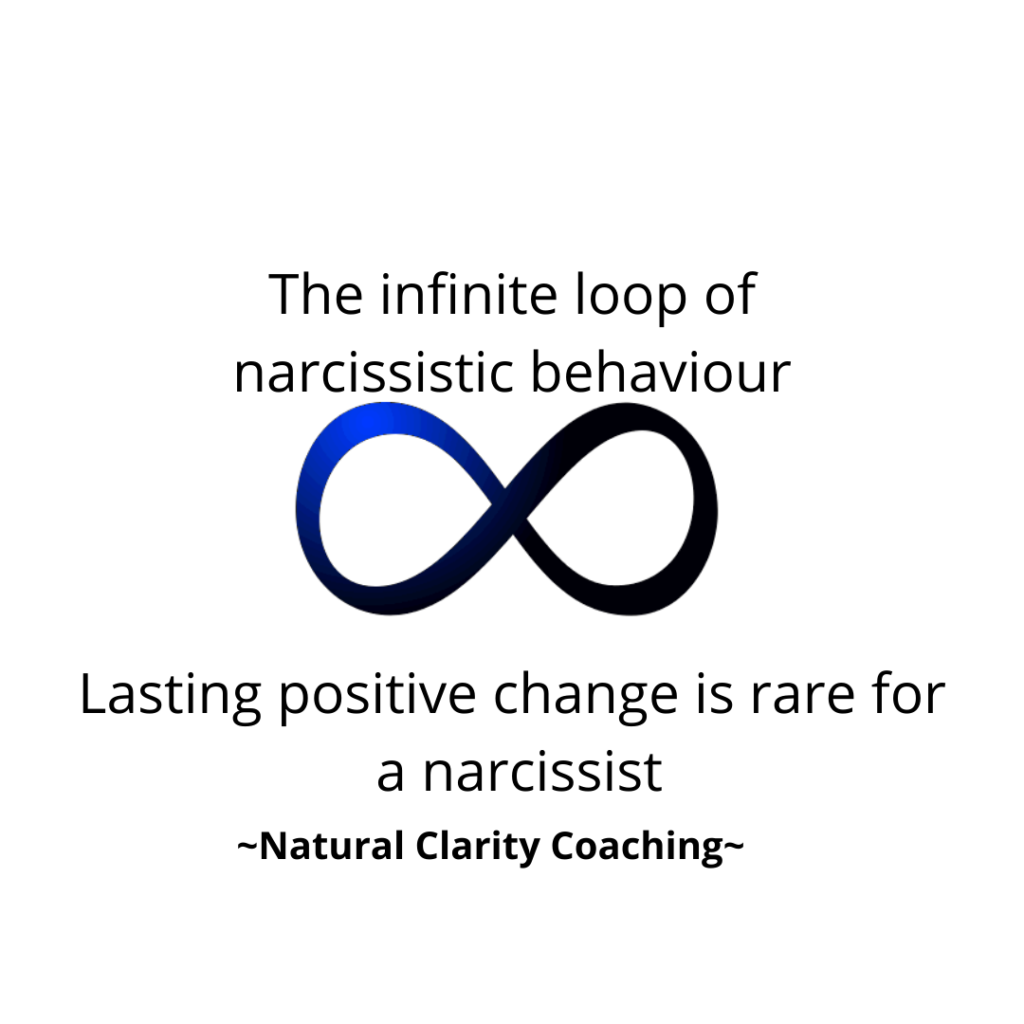
Don’t expect lasting, authentic, positive change from a narcissist

Narcissists rarely change; not in any authentic way. If they appear to have done so, it’s likely to not be genuine or long-term and is just being used as a tactic to manipulate someone or obtain something. Of the many narcissistically-inclined individuals I’ve known, the stories I’ve heard over the years, the articles I’ve read, the training/education I’ve had on this personality type – they simply don’t tend to change. I won’t say ‘never’ because, well, there could be that rare person who beats the odds. Stranger things have happened. In my experience, though, I’ve yet to see a narcissist change, particularly for the better. In times where I’ve cut a toxic, narcissistic individual out of my life and then heard something about them years later, they’re still doing exactly the same things to their targets. Same cycle over and over and over again, just with different pawns playing in their toxic game.

I’ve had conversations with a narcissist who, on multiple occasions, promised not to do/say something that was emotionally hurting a loved one and then, literally five minutes later, did it again, right in front of me. The need for extreme ego protection and stroking keeps narcissists locked into their behaviour. And because they lack empathy, not even the continued pain they typically create for others will cause them to alter their ways. They convince themselves that the hurt they create is justified and, many times, build up scenarios in which they’re not only hurting people but also making it seem as though those very people have actually been hurting them.

So, if you’re in a relationship of any kind with a narcissist, it’s not advisable to get your hopes up that they will ever change for the better in any lasting way. It doesn’t usually happen with this type of disordered individual. You can try to explain decent and honest behaviour to them until you’re blue in the face; you can drag them to counselling with you; you can attempt to convey your perspective ten times over in the hopes that maybe they’ll finally listen to you but the fact remains that a narcissist is a narcissist is a narcissist. The chances of them ‘getting it’, accepting it and wanting to do something about it are slim to nil.

One of the best things any of us can do when we have a narcissist in our lives is to go no contact or low contact with them. Family, romantic partner, friend, co-worker – whoever it may be, we need to protect ourselves. Waiting around for them to change just causes more damage and wastes our time; time that we could be spending doing something we enjoy either on our own or with emotionally healthy people instead. Narcissists exist in an infinite, inauthentic, dysfunctional loop and, in general, have zero interest in putting an end to it. If we refuse to get caught up in that loop with them, we’re doing ourselves a huge favor.

Until next time,

Heather ~Natural Clarity Coaching~ www.naturalclaritycoaching.com na********************@***il.com Natural Clarity Coaching on Facebook, Instagram and Twitter

« Older posts Newer posts »