Tag: adult children of narcissists (Page 10 of 13)

Happy Holidays!

To all of the visitors to this website, thank you for stopping by!  And to those who celebrate Christmas, I’m sending out a hearty Merry Christmas to you!  For anyone who’s struggling this holiday season, take a peek at the previous post for some tips.

Until next time,

Heather ~Natural Clarity Coaching~ naturalclaritycoaching.com na********************@***il.com Natural Clarity Coaching on Facebook, Instagram, LinkedIn, and Twitter

Happy Holidays! Here’s some tips to help you get through, especially if toxic people are in the picture

Well, here we go.  Another holiday season is upon us.  While special occasions should be enjoyable, they can be quite the opposite when toxic people are involved.  Be they partners, family, friends, coworkers, etc., some people seem to drag their drama and unpleasantries to every party, gathering, and dinner table when the holidays come around.

As I’ve mentioned in previous posts, if we need/want to attend events that will include narcissists and other difficult people, boundaries are always at our disposal.  That could include avoiding conversations, speaking minimally if we get pulled into any chit-chat, or walking away if we feel the need to do so.  It’s possible to be polite and not make a scene when attempting to avoid contact with someone.  Unless we’d like to make a scene, of course.  In that case, go for it!  Just be true to you, whatever that may look like.  And even if we’re in a room full of enablers (flying monkeys) of the toxic person/people, we can hold our heads high while recognizing that narcissists are very convincing, manipulative people who can pull the wool over some people’s eyes.  But that often changes.  Until then, we can define it as one of those “it is what it is” situations.  In the end, the behaviour of toxic people and their dutiful flying monkeys has absolutely nothing to do with us.  We just happen to be the (often scapegoated) current target of their misery and drama.

We can also choose not to attend events at which the person or people in question may be.  Yes, it sucks to miss out but we need to weigh that against loss of peace and increases in stress levels.

For those of us who are low- or no-contact and have been choosing not to attend events with certain individuals, the little worm of loneliness may try to creep in.  But we can ignore that feeling by keeping ourselves busy with new traditions, hobbies, or making plans for spending time with people who are less challenging to be around.

And above all else, make time for self-care.  Even five minutes can help if that’s all the time we can manage.  Deep breathing, yoga, going for a walk, time with friends, a warm bath…whatever gives us some downtime and relaxation can make a world of difference.  Absolutely every little moment of self-care helps our bodies, minds, and spirits to stay resilient and provides optimal chances for overall wellbeing.

Happy Holidays!  We can do this! 

Until next time,

Heather ~Natural Clarity Coaching~ naturalclaritycoaching.com na********************@***il.com Natural Clarity Coaching on Facebook, Instagram, LinkedIn, and Twitter

Social Determinants of Health and Growing up in a Dysfunctional Family (Possibly with Narcissists)

In my current university program studies, a certain number of electives are required in order to fulfill the requirements of a degree.  Last year, I stumbled across an elective course on the subject of the social determinants of health (SDoH).  It sounded interesting so I decided to take it.  I have since taken two more courses on related subjects on health inequities and health promotions/interventions.  To say that I’m intrigued would be an understatement.

So, if you haven’t already heard of them, the SDoH are:  “the non-medical factors that influence health outcomes. They are the conditions in which people are born, grow, work, live, and age, and the wider set of forces and systems shaping the conditions of daily life” (CDC, 2022).  Further, SDoH are “linked to a lack of opportunity and resources to protect, improve, and maintain health. Taken together, these factors create health inequities— types of health disparities that stem from unfair and unjust systems, policies, and practices, and limit access to the opportunities and resources needed to live the healthiest life possible” (CDC, 2022).

Borrowed from CMHA - Ontario

Borrowed from CMHA – Ontario

To be more specific, SDoH come in many forms:

  • unemployment and job security
  • gender
  • Indigenous status
  • disability
  • housing
  • early life
  • income and income distribution
  • education
  • race
  • employment and working conditions
  • social exclusion
  • food insecurity
  • social safety net
  • health services

Looking at the example of early life, unresolved childhood trauma can result in mental health and/or addictions issues, to name just two.

I think it’s easy to see how growing up (early life)  with, for example, a narcissistic parent could be considered a social determinant of health, encompassing the holistic (whole person) levels of mental, physical, spiritual, emotional, and social health.   These experiences have the strong potential to send us down paths that lead to serious impacts which negatively affect our overall health and wellbeing. There are obviously other SDoH’s listed above that could be linked with a dysfunctional upbringing.

With this knowledge in hand, a strong response as, say, an adult child of a narcissist(s) acquiring awareness of their disordered childhood and onward, would be: educating oneself on narcissism and its far-reaching, negative effects in order to understand the ‘why’ and ‘how’ on a personal level; engaging in regular self-care; accessing professional resources (mental health, coaching, wellness, etc.) to assist in their healing journey; and so on.  Focusing on the hurt caused by a toxic person or people doesn’t typically aid in healthy, positive progress.  But what does help is acknowledging the pain, understanding the mechanisms behind the dysfunctional behaviour and its impacts on us as targets, and then focusing on healing ourselves so that we can find peace and fulfillment in our lives and relationships of our choosing (as opposed to ones we were born into, should we decide we no longer wish to maintain them).

We owe it to ourselves to be resilient and move forward despite what we’ve endured.  Is it an easy task?  Definitely not.  But is it worth it?  Absolutely, 100 percent.  The possibilities for our lives are virtually limitless when we acquire the coping tools to see beyond the effects of the cloud of abuse and dysfunction, and maybe even remove ourselves from its unpleasant influence altogether.  That’s an entirely different topic, though – see previous posts on low contact and no contact.

More on this in future posts.

Until next time,

Heather ~Natural Clarity Coaching~ naturalclaritycoaching.com na********************@***il.com Natural Clarity Coaching on Facebook, Instagram, LinkedIn, and Twitter
The betrayal of a toxic family system

Toxic family systems bring with them SO much distress, pain, and harsh betrayal.  Here’s a few of the reasons (set in the context of a narcissistic family) for why that happens:

  1.  A narcissist is at the helm and center of the family, ruling it with brutal control, manipulation, and constant drama.  There’s virtually no peace to be found, particularly for the scapegoated child.
  2. A narcissist parent typically has an enabling parent by their side.  The enabler, in an effort to spare themselves and keep in good stead with the narcissist, will refuse to hear other perspectives, let alone protect or defend the scapegoat.  Scapegoats are left feeling alone, without a voice, and ganged up on.
  3. Scapegoats live a life filled with judgment, criticism, blame, and control.  The narcissist parent targets them on a regular basis, while the enabling parent either joins forces with the narcissist or silently stands back and watches it happen.
  4. Scapegoats are often pitted against the golden child(ren) of the family, and they are set up to lose every time.  And if they stand up for themselves regarding their dislike for competition with family members, the narcissist parent may tell them that they’re weak and/or jealous of their sibling.
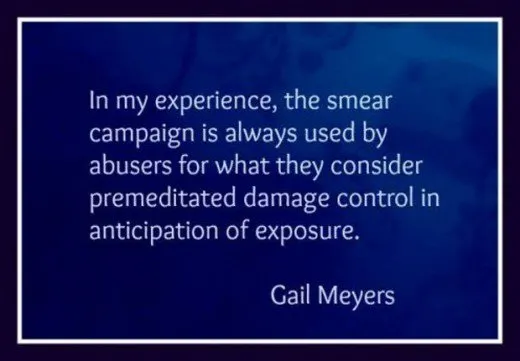
  5. When a scapegoat takes a stand, the narcissist parent will come after them in some way.  This may involve personal attacks, silent treatments, or smear campaigns.  These tactics are used by narcissists to bring people back under their control.
  6. Toxic family systems revolve around the narcissist or other disordered individual, and there is very little normalcy within this system.  The irony is that toxic people will claim that the family is “perfect” and “better than other families”, leaving scapegoats and their siblings with a skewed picture of what healthy family systems should look like.  From there, the scene is set for these individuals to go on to other dysfunctional relationships, thinking they’re ‘normal’ if they look like the system they grew up in.

Above all else, toxic families present the ultimate betrayal.  They leave members, particularly scapegoats, feeling unloved, insignificant, alone, abused, confused, bullied, useless, responsible for all that is wrong in the family, and flawed beyond hope.  And then all of these feelings and beliefs, based on the type of ‘love’ (which is not love at all) experienced in this family system, set members up to be at high risk for winding up in other toxic relationships as adults.

There is hope, though, no matter how much time has elapsed, and it starts with self-love.  Toxic family systems, through their dysfunctional dynamics and behaviours, generally teach self-loathing and self-hatred.  When we learn to love ourselves, we start on the path of setting ourselves free from the toxicity and false narratives.  We deserve peace and love, and both of those things can be created from within ourselves.

Until next time,

Heather ~Natural Clarity Coaching~ naturalclaritycoaching.com na********************@***il.com Natural Clarity Coaching on Facebook, Instagram, LinkedIn, and Twitter

Narcissists love fanning the flames of discord, especially against scapegoats

For anyone who has had issues with a narcissist or other toxic individual, it is evident that they love to fan the flames of discord. Oh, they’ll smile and try to hide the bellows behind their back, but they’re definitely keeping that fire nice and hot when no one is looking.

When a narcissist chooses a scapegoat (or sometimes more than one), within a family, workplace, or other environment, they then need to continue the narrative against that person at all costs. Without the continuation of this false narrative they have created against their target(s), the entire system upon which they bolster their fragile ego, is at risk of collapsing. This is especially true when they feel that their control is being threatened. Some examples of this may be an enabling parent showing kindness or some other form of positivity towards a scapegoated child, or it could be a scapegoated individual in the workplace who is having a friendly chat with a “flying monkey” co-worker in the lunchroom. Narcissists in particular can’t allow those types of things to happen because it goes against the picture they’ve painted of their target, and they also don’t want to risk people having a discussion about them and discovering the truth.

When toxic people feel threatened, they react with more manipulation and aggression. Basically, they start what is known as a smear campaign. They call their enablers to action through more lies, negativity, and exaggerations about their targets. They ramp up their alleged role of victim in their twisted game where they are, in fact, anything but victims. And their enablers naively jump to their defence and (in their minds) heroically rescue them from such horrible behaviour. Most of the time, enablers and flying monkeys don’t even attempt to hear anyone else’s side of the story. They flat out believe the nonsense they’re being fed. In my experience, some enablers will also return to scapegoating the narcissist’s target simply to bring an end to the ranting and raging. What they truly believe is anyone’s guess; their goal is simply to find a (usually temporary) reprieve from the toxic person’s thunderstorm. Overall, though, toxic people will pull out all the stops in an effort to maintain their control and position within their environment. Those false narratives are the very foundation of the protection of their egos. If they couldn’t triangulate and place blame on others, then they might ultimately be asked by their enablers to face accountability or, even worse, be forced to honestly evaluate themselves and engage in introspection. To a narcissist or other toxic individual, that would be a fate worse than death.

So if we’re the scapegoat and we recognize, based on the behaviour of others, that the narcissist/toxic person in our life has been frantically pumping those bellows and turning up the heat against us, even though we’re typically left in the dark as to what has been said, what can we do? Well, that varies by individual. One method that people find useful is to not JADE; that is, don’t Justify, Argue, Defend, or Explain. Yes, that’s a challenging task. No one wants to have lies floating around about them, and it’s human nature to want to JADE. But another more viable option is to simply live our lives and let our behaviour speak for itself. And in all honesty, silence speaks volumes, people. It truly does. There will always be enablers and flying monkeys. That’s just a fact of life. It lies with us to decide how much we will allow those dynamics to create negative personal impacts for us. Yet another option is to learn to let go of or distance ourselves from people who don’t see us as we truly are, but, rather, choose to believe the tales being spun about us by toxic people who are all about being in control and actively working to destroy relationships that they feel threatened by. Even though it’s easy to feel trapped within toxic systems, and we’ve often been trained to feel that we’re permanently stuck, helpless, and lacking any control over our own lives, we do have choices as to how we react to toxicity and dysfunction being aimed at us. We truly do have power. Remembering that fact and feeling empowered by it is half the battle.

Until next time,

Heather ~Natural Clarity Coaching~ naturalclaritycoaching.com na********************@***il.com Natural Clarity Coaching on Facebook, Instagram, LinkedIn, and Twitter

Does ‘no contact’ work?

Hi everyone. After a late-summer holiday, I started back to my university psychology studies. So I’ve been busy. But I wanted to sit down and write a post.

‘No contact’ – does it work? First of all, ‘no contact’ refers to exactly what it sounds like: not being in contact with a particular person or people. Zero interactions of any kind. In many cases, we may decide, in our own best interest, that we can’t be in touch with toxic people. So we then refrain from contacting them or accepting any form of communications from them. We can let people know this is happening in advance, or we can simply make it happen. It’s our choice how we do it.

There’s no doubt that ‘no contact’ can be very challenging to implement at first, particularly if the person or people in question have been a big part of our lives. So it’s best to be prepared for those feelings. As time passes, though, many of us find that peace begins to settle into our lives as a result of keeping ourselves safe from toxic people, and we will become increasingly protective of that peace.

To answer the original question, yes, ‘no contact’ works. So does ‘low contact’ when it’s done on our terms. But it has to be 100 % adhered to on a continual basis. And once peace has settled in, even thinking about reaching out to the person (or beyond ‘low contact’, if that’s what we’ve chosen) will be a thing of the past. Realizing our value and that we deserve respect and a peaceful existence are strong contributors to maintaining boundaries.

Lastly, it’s best not to allow feelings of guilt to get the best of us after we’ve made this decision. Flying monkeys may take a run at harassing us to reconnect with the toxic individual. The toxic person themselves may try to confront us in order to reestablish the status quo. And as people who have been targets of their abusive behaviours, we may already be programmed to quickly or even automatically believe that we’re doing something wrong and should be ashamed. Drop the programming like a bad habit and recognize that we all make our own choices and it’s okay to not want to be treated disrespectfully and abusively. And we have the right to keep people out of our lives if they aren’t good for us. No matter what we may have been told, we have the right to peace and to protect ourselves from anyone at any time.

Until next time,

Heather ~Natural Clarity Coaching~ naturalclaritycoaching.com na********************@***il.com Natural Clarity Coaching on Facebook, Instagram, LinkedIn, and Twitter

It’s YOUR Life

As a member of many online groups on the subject of dealing with narcissists and other toxic individuals, I have observed a variety of common themes within posts. A main current is that of one’s life not feeling like their own. This typically takes the shape of people being almost constantly bombarded with opinions, criticisms, and unsolicited advice about how they should be living their lives, particularly as adults. And, taking it one step further, if the individual doesn’t conform to the opinions, criticisms, and unsolicited advice of these people (narcissistic parents, partners, friends, colleagues, etc.), they will be faced with some form of punishment such as the silent treatment or abandonment, guilt-tripping, a smear campaign, or some other manipulative treatment meant to cause someone to “do as they’re told”.

What we need to keep in mind is that this is OUR life. No one else has the right to tell us how to live it, nor do we owe anyone explanations for our decisions. If someone feels that it’s acceptable to dole out punishment because we have not followed their advice on something within our own life, that’s very telling of their character and not ours. And we have no obligation whatsoever to anyone but ourselves when it comes to our life decisions. Going forward, we may also need to evaluate our relationships with those who feel that they are justified in telling us how to live and then trying to manipulate and control us into doing what they want. There are ways (such as low or no contact, placing boundaries, etc.) to protect ourselves from that type of behaviour.

If we follow our hearts and dreams, trust ourselves as captains of our own ships, and steer clear of other people’s unsolicited interference in our decision-making (very different situation from those times we may approach a trusted individual for advice), we will be fine. And, in all honesty, we all make mistakes. We’re human. As long as we learn from those mistakes, that’s all part and parcel of a growth mindset. It makes us stronger, gives us greater knowledge and experience, and empowers us as we journey through life. No one is intended to have others run their life for them. Nor should we feel guilty or wrong if we make our own decisions. We need to take our own path, believe in ourselves, and not be held back by anyone or anything. So, get out there and live life to its fullest and on your own terms.

Until next time,

Heather ~Natural Clarity Coaching~ naturalclaritycoaching.com na********************@***il.com Natural Clarity Coaching on Facebook, Instagram, LinkedIn, and Twitter

They make it about you because it can’t be about them

It’s intriguing how narcissistically-inclined individuals refuse to take the blame for anything, even when everyone involved is aware that they are clearly at fault. Definitely a case of ego protection. Fragile egos cannot withstand being wrong…ever. And one of the best add-ons to refusing to take the blame is often putting that blame onto others.

Using family as an example, if we happen to be the scapegoat, that makes us the ongoing target of narcissists or other toxic people who need to shift the direction in which fingers are pointing. Plus, it’s easy for a dysfunctional family to accept without question that the designated scapegoat is the problem, even without any evidence or so much as asking for their perspective on the matter at hand. This could also happen in the workplace, social situations, or other environments.

So the next time that you are blamed for something you didn’t do, say, or whatever the accusation entails, consider the source. Is this someone with a fragile ego? Have you thought of them being narcissistic in nature? Do they have to be ‘right’ at all costs in order to continue their mask of perfection? Have they dragged you into it as a scapegoat for their own behaviour? Or is this person a flying monkey, acting on behalf of a narcissist who’s trying to shift blame? If so, stay strong. Take the emotion out and consider the mechanics of it. When you look at the situation from a neutral state, it’s much less complicated to approach. Avoiding JADE-ing – Justify, Argue, Defend, Explain – will also be useful. None of that is necessary. Walk away if you can. Say as little as possible. Don’t engage with the blame projector or anyone who is encouraging or furthering their accusations. Hold your head high. People (particularly flying monkeys) will believe what they want to believe, no matter what we say or do. Know that this has nothing to do with you and you owe no one any explanations or apologies. If you absolutely need to speak for yourself, stick to the facts and leave that emotional component out of it.

And remember, they make it about you because they literally aren’t strong enough for it to be about them. They can’t be wrong. They refuse to be accountable as a result. This is a disordered person and, usually, their merry band of enablers on the sidelines. No amount of explaining, putting forward evidence, or pointing the finger will improve the situation. Narcissists and assorted other toxic people will not back down, especially if it involves their egos taking a hit. It helps to focus on being grateful that you don’t need to live your life like that. Think about how much energy is required to behave in that fashion and continually find ways to protect against any hits to the ego. Leave them to their devices and move forward. It isn’t easy to be blamed for other people’s actions. But accepting the blame is an entirely different aspect. Just because someone says it, doesn’t make it true, nor does it mean we need to accept it. Know yourself and stay loyal to who you are, regardless of whatever chaos may be swirling around.

Trust me when I say that the more you practice leaving the emotion out of interactions with narcissists or their supporters, the easier it gets to stay calm and not be affected by their behaviour. This leads to improved awareness and empowerment, which allows us the tools to avoid being trapped in the future webs of narcissists. Stay strong and aware, my friends! We’ve got this!

Until next time,

Heather ~Natural Clarity Coaching~ naturalclaritycoaching.com na********************@***il.com Natural Clarity Coaching on Facebook, Instagram, LinkedIn, and Twitter

Finding the ‘you’ that you never knew

When you’ve spent time under the thumb of a narcissist, particularly from your childhood, you might never have had an opportunity to get to know who you truly are. Narcissists typically tell us who we need to be, how to be, why to be, and who we are (in negative tones), and, in order to avoid chaos and disapproval, we tend to do whatever it is they want and accept what they tell us. So we aren’t really ourselves in this mode. We’re simply who we’re told to be or are accused of being. It’s like being stuck in a shell with the real you hidden inside.

When we make the choice to go low or no contact with the narcissists in our lives, it gives us time and freedom to get in touch with our true self. We may think that we like certain things, only to discover that we don’t…at all. Those things may have been what we were told to like or that someone assessed us as liking. And we may believe ourselves to be a specific personality type, only to discover that it isn’t us…at all. That’s who we were told to be or who we were told we were in a negative way. For example, “You need to act more like your (golden child) sibling” or “You’re so (fill in the blank with a derogatory term related to character)”. We may also feel certain ways about our appearance, based on how the narcissist in our life described us, which will typically have been unflattering. Once we have a chance to look in the mirror and really assess what we see without biases, we may discover that our physical being is not what we believed it to be, either.

If we are able to free ourselves from narcissists in whatever way we choose (boundaries, low contact, no contact), we give ourselves a new lease on life and on finding who we are, possibly for the first time ever. We generally find that we don’t need to be who we’re told to be or who we’ve always been accused of being. And that’s a real gift! Be aware, though, that it can be challenging to realize that we may have never really known the ‘real’ us. Maybe someone will ask us what we like to do for a hobby and we don’t have an answer no matter how much we think about it. Or maybe we’ll be asked to do something that we’ve been led to believe we aren’t capable of and we’re hesitant to step out of our comfort zone for fear of failure and the ridicule that typically followed from narcissists.

Here’s the thing – our lives are gifts that we should make the most of each and every day. Restricting ourselves to the confines and limits of other people’s beliefs and biases does us a great disservice and creates missed opportunities. This can all lead to guilt, grief, and depression. We owe it to ourselves to find who we are and live the life we’re meant to live. It’s no simple task but it’s well worth the effort. Find that you that you never knew.

Until next time,

Heather ~Natural Clarity Coaching~ naturalclaritycoaching.com na********************@***il.com Natural Clarity Coaching on Facebook, Instagram, LinkedIn and Twitter

Music As a Tool For Coping

Growing up, I spent hours upon hours soaking up music. As a musician from a young age, performing and listening to music of many genres was and continues to be a big deal for me. Music takes me to different spaces, carries me out of my body to ethereal locations, and provides calm and relaxation in ways that most other things don’t come close to achieving.

I didn’t realize it at the time but music (and my Grandma) literally kept me sane. Well, that and a cache of inner strength that existed deep inside me, outside of my young awareness. In fact, it was many years later, when a therapist mentioned this strength that she saw in me, that I was able to recognize it. When important people in your childhood constantly place so much emphasis on your supposed weaknesses, you don’t often look for the strengths in yourself. Music was my safe space and companion in an emotionally, and sometimes physically, unstable and hurtful home environment. This revelation came to me as an adult, long after I had left my childhood behind. When I revisit music from, say, my teenage years, I recognize what my subconscious was embracing in the lyrics. Back then, I don’t know if it truly registered because I believe I was – at a conscious level – unaware of my circumstances. When you’ve been taught that your family is “perfect”, you believe that everything is completely normal. In my case, I had been so well-conditioned to accept everything I was told (scapegoat, black sheep, etc.) that I didn’t question any of it. My thinking at the time was that if I was being given the silent treatment for days on end, for example, then I had done something to deserve it. End of story.

As an adult, music is still one of my main go-to’s. Happy, sad, upset, frustrated, bored…music is and has always been there for me. I can sit down at the piano and play whatever pieces I feel like playing. Or I can pick up my headphones and listen to whatever suits my mood. Both are very cathartic acts of self-care.

Music…I recommend that everyone should keep it in their coping toolbox. Looking back, I’m incredibly grateful for everything it helped carry me through, especially when I didn’t realize just how important it was for my sanity. I have no doubt that my intuition brought me to it for much-needed therapy and healing.

Until next time,

Heather ~Natural Clarity Coaching~ naturalclaritycoaching.com na********************@***il.com Natural Clarity Coaching on Facebook, Instagram, LinkedIn, and Twitter

« Older posts Newer posts »