Yes, it’s possible for a narcissist to have been, or still be, a scapegoat. This is particularly true when they have been narcissistically abused by a parent or guardian. It isn’t necessarily golden children who may become egotistical and/or narcissistic.
I’ll share a bit about the case of an individual (not a client) who grew up with three siblings. He has two sisters and an older brother. This brother is the golden child of the family, while the person I mentioned was – and still is – the scapegoat. His mother never has a kind or complimentary thing to say about him, and she does her best to control everything in his life, which has led him to many downfalls. And yet she raves about her oldest son while continuing to criticize her other adult son. Of note is the fact that her oldest son is quite a narcissist himself but couldn’t do wrong in her eyes if he tried.
In this particular situation, this narcissistic mother believed herself to have been an outstanding farmer with a huge cattle operation when her children were young, and yet accounts from others – including her scapegoated son – were that they lived on a relatively small hobby farm that never amounted to much. Livestock was not well cared for, plentiful crops evaded her, and veggie gardens were not productive. But the point to be made here is that she has always placed immense importance on farming because, in her narcissistic mind, she felt that she was exceptional at it. And so, her scapegoated son has spent his life to date attempting to become a farmer that his toxic mother would be proud of. He has poured tens of thousands of dollars into creating what he thinks would impress her. He lost his family over the obsession, although his alcoholism and narcissistic abuse were also major contributing factors. Yet, in the end, he has never been successful at farming despite decades of trying. Why? Because it isn’t his dream. It’s his mother’s dream. And the sad fact is that even if he were to be successful, it would never be enough for her. He will never receive the love and validation that he has craved from his mother for his entire life.
This scapegoated narcissist will likely spend all his days attempting to live out someone else’s dreams in the hopes of finally being acknowledged and praised by someone who is incapable of giving that to him. His only release may come about when his mother passes on.
So, yes, narcissists can simultaneously be scapegoats. The hits to the ego that are a part of being a scapegoated child have the potential to turn a person into an ego-protecting and abusive narcissist, seeking out their own scapegoats, while continuing to be narcissistically abused by a disordered parent. Sad mixture, for certain.
Everyone has a story that has brought them to their current chapter. While it’s a challenge to feel sympathy for narcissists, simply trying to put oneself in their shoes for a few moments is often enough to shine a spotlight on their unpleasant existence. If nothing else, it allows for a glimpse into why they behave the way they do. We don’t have to forgive if we don’t choose to, but sometimes it helps to understand why narcissists are they way they are. It allows us to know that it has nothing to do with us but everything to do with their own internal chaos.
When we decide to go low contact or no contact with dysfunctional family members, friends, partners, workplaces, and so on, what happens to those individuals and the toxic system? It doesn’t really matter as far as our own healing and progress is concerned, but it’s interesting to consider it.
In the case of, say, a narcissistic romantic partner, there may be an initial attempt at keeping the relationship intact but they will typically move on to a new person (aka source of supply, meaning someone to keep their ego happy temporarily). When there are children involved, there may be issues, but there is definitely an assortment of legal and other means of managing everything. Toxic workplaces would be similar to romantic partners because there will typically be someone there to fill the void space, as would be the case with the majority of toxic friends (particularly ones with shallow bonds).
But when it comes to a toxic family system with, potentially, a narcissist at the helm, what happens when, say, the scapegoat leaves through low contact or no contact? This is different than the relationships noted above. Family systems have incredibly lengthy histories, with specific people who “play” certain roles. For example, with a narcissistic mother as the dominant individual, there will quite likely be an enabling father. And there will be a child or children who are the scapegoat or the golden child. The dysfunctional family system, and particularly the narcissist, needs everyone to stay in order to maintain the status quo. And the people within the system can’t simply be replaced. This toxic system can often include extended family members, such as grandparents, aunts, uncles, cousins, and others. In order to survive, it needs its members to remain in the loop and to play their given parts.
So, scapegoats will often experience attempts by family members to keep them drawn into the mix. A narcissistic parent needs the scapegoat; to talk about, complain about, blame, control, condescend to, put down, manipulate. Without this relational dynamic, the narcissist’s system falls apart. This is at the very root of the entire game they play to feed their fragile egos. How can they play the victim or place blame if the scapegoat isn’t available? Who do they compare their golden child to, if not the scapegoat? How do they pass their time with, perhaps, an enabling partner if they don’t have their usual scapegoat fodder to regularly discuss and dissect? It may not even be the narcissistic parent who attempts to draw a scapegoat back into the fold. In fact, they’re more likely to play the victim of ‘abandonment’ and then encourage others to do the convincing on their behalf. It could be the enabling parent, siblings, other relatives, or flying monkeys (people who do the narcissist’s bidding on the mistaken belief that the narcissist is being victimized) who are friends of the narcissist. Why? Because they likely feel ill at ease with the shift in the system, in addition to having to deal with an angry narcissist who, without their fall guy, might now be aiming their increased victim charade, outbursts, blaming, and negative behaviour at other people. Everyone in the system wants to keep the narcissist happy, if only to make their own lives less difficult. Just like a loss of hydro to a home, the goal of a toxic family that has lost its integral scapegoat is to reinstitute them in their role and put the system back to ‘normal’.
To sum it up, toxic family systems will be turned on their heads when a scapegoat makes the decision to remove themselves. And those who remain will struggle with the change and will have a tendency to want to bring everything back as it was. Holding an awareness of this can be of great benefit for scapegoats. We may get the emotional impression management treatment from family members who want us to return to our role so that everything will be back in place. “We all miss you, please come back. We’re your family”. But the sad truth is that they don’t miss ‘us’; they miss the perceived stability of the toxic system, whether they realize it or not. Everyone needs to play their part to keep the dysfunction alive and well in order to have even the slightest chance of a bit of peace in their lives. This system is familiar and it’s what keeps narcissists as content as they can be, which means that everything can keep rolling along, as well as it possibly can in such a disordered environment. When we leave, they want us to return, but not for the right reasons.
Until next time,
Heather ~Natural Clarity Coaching~ naturalclaritycoaching.com na********************@***il.com Natural Clarity Coaching on Facebook, Instagram, LinkedIn, and Twitter
For anyone who has had issues with a narcissist or other toxic individual, it is evident that they love to fan the flames of discord. Oh, they’ll smile and try to hide the bellows behind their back, but they’re definitely keeping that fire nice and hot when no one is looking.
When a narcissist chooses a scapegoat (or sometimes more than one), within a family, workplace, or other environment, they then need to continue the narrative against that person at all costs. Without the continuation of this false narrative they have created against their target(s), the entire system upon which they bolster their fragile ego, is at risk of collapsing. This is especially true when they feel that their control is being threatened. Some examples of this may be an enabling parent showing kindness or some other form of positivity towards a scapegoated child, or it could be a scapegoated individual in the workplace who is having a friendly chat with a “flying monkey” co-worker in the lunchroom. Narcissists in particular can’t allow those types of things to happen because it goes against the picture they’ve painted of their target, and they also don’t want to risk people having a discussion about them and discovering the truth.
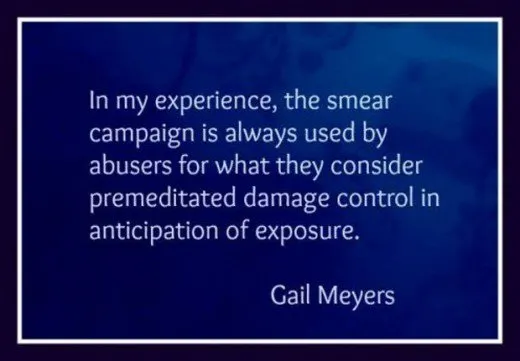
When toxic people feel threatened, they react with more manipulation and aggression. Basically, they start what is known as a smear campaign. They call their enablers to action through more lies, negativity, and exaggerations about their targets. They ramp up their alleged role of victim in their twisted game where they are, in fact, anything but victims. And their enablers naively jump to their defence and (in their minds) heroically rescue them from such horrible behaviour. Most of the time, enablers and flying monkeys don’t even attempt to hear anyone else’s side of the story. They flat out believe the nonsense they’re being fed. In my experience, some enablers will also return to scapegoating the narcissist’s target simply to bring an end to the ranting and raging. What they truly believe is anyone’s guess; their goal is simply to find a (usually temporary) reprieve from the toxic person’s thunderstorm. Overall, though, toxic people will pull out all the stops in an effort to maintain their control and position within their environment. Those false narratives are the very foundation of the protection of their egos. If they couldn’t triangulate and place blame on others, then they might ultimately be asked by their enablers to face accountability or, even worse, be forced to honestly evaluate themselves and engage in introspection. To a narcissist or other toxic individual, that would be a fate worse than death.
So if we’re the scapegoat and we recognize, based on the behaviour of others, that the narcissist/toxic person in our life has been frantically pumping those bellows and turning up the heat against us, even though we’re typically left in the dark as to what has been said, what can we do? Well, that varies by individual. One method that people find useful is to not JADE; that is, don’t Justify, Argue, Defend, or Explain. Yes, that’s a challenging task. No one wants to have lies floating around about them, and it’s human nature to want to JADE. But another more viable option is to simply live our lives and let our behaviour speak for itself. And in all honesty, silence speaks volumes, people. It truly does. There will always be enablers and flying monkeys. That’s just a fact of life. It lies with us to decide how much we will allow those dynamics to create negative personal impacts for us. Yet another option is to learn to let go of or distance ourselves from people who don’t see us as we truly are, but, rather, choose to believe the tales being spun about us by toxic people who are all about being in control and actively working to destroy relationships that they feel threatened by. Even though it’s easy to feel trapped within toxic systems, and we’ve often been trained to feel that we’re permanently stuck, helpless, and lacking any control over our own lives, we do have choices as to how we react to toxicity and dysfunction being aimed at us. We truly do have power. Remembering that fact and feeling empowered by it is half the battle.
Until next time,
Heather ~Natural Clarity Coaching~ naturalclaritycoaching.com na********************@***il.com Natural Clarity Coaching on Facebook, Instagram, LinkedIn, and Twitter
As a member of many online groups on the subject of dealing with narcissists and other toxic individuals, I have observed a variety of common themes within posts. A main current is that of one’s life not feeling like their own. This typically takes the shape of people being almost constantly bombarded with opinions, criticisms, and unsolicited advice about how they should be living their lives, particularly as adults. And, taking it one step further, if the individual doesn’t conform to the opinions, criticisms, and unsolicited advice of these people (narcissistic parents, partners, friends, colleagues, etc.), they will be faced with some form of punishment such as the silent treatment or abandonment, guilt-tripping, a smear campaign, or some other manipulative treatment meant to cause someone to “do as they’re told”.
What we need to keep in mind is that this is OUR life. No one else has the right to tell us how to live it, nor do we owe anyone explanations for our decisions. If someone feels that it’s acceptable to dole out punishment because we have not followed their advice on something within our own life, that’s very telling of their character and not ours. And we have no obligation whatsoever to anyone but ourselves when it comes to our life decisions. Going forward, we may also need to evaluate our relationships with those who feel that they are justified in telling us how to live and then trying to manipulate and control us into doing what they want. There are ways (such as low or no contact, placing boundaries, etc.) to protect ourselves from that type of behaviour.
If we follow our hearts and dreams, trust ourselves as captains of our own ships, and steer clear of other people’s unsolicited interference in our decision-making (very different situation from those times we may approach a trusted individual for advice), we will be fine. And, in all honesty, we all make mistakes. We’re human. As long as we learn from those mistakes, that’s all part and parcel of a growth mindset. It makes us stronger, gives us greater knowledge and experience, and empowers us as we journey through life. No one is intended to have others run their life for them. Nor should we feel guilty or wrong if we make our own decisions. We need to take our own path, believe in ourselves, and not be held back by anyone or anything. So, get out there and live life to its fullest and on your own terms.
Until next time,
Heather ~Natural Clarity Coaching~ naturalclaritycoaching.com na********************@***il.com Natural Clarity Coaching on Facebook, Instagram, LinkedIn, and Twitter
For everyone who finds special occasions like today, Father’s Day, challenging for any reason, I get it. If special occasions also feel like walking on egg shells (or possibly landmines), I completely understand where you’re coming from. This can be particularly so when narcissists are in the picture.
If your family of origin involved narcissism, special occasions were likely incredibly challenging to deal with from early in your life and probably remained that way throughout your childhood and into adulthood. Maybe the narcissistically-inclined parent was your mom, or maybe your dad, or maybe both of your parents. Whoever it was, it’s highly likely that special occasions were often drama-filled, emotionally draining and confusing events during your childhood and possibly into adulthood.
When it comes to narcissists, they feel the need to always be the center of attention, even on special occasions that have nothing to do with them. They will cause drama, upheaval and emotional upset by whatever means necessary. Maybe they’re sulking because the day isn’t about them but they’re making it appear as though someone slighted them and caused the issue. Or maybe they’re starting arguments because they want to take the attention away from the special occasion. It’s possible that they will criticize the people who are trying to celebrate by saying that their efforts aren’t good enough or they’ve done everything wrong. Whatever it may be, narcissists very commonly ruin special occasions, all for the need to be the constant focus of the family. And that toxic, narcissistic energy often attaches to special occasions and can bring apprehension and anxiety to other family members year after year after year. What is Mom going to do to ruin everything this year? What will Dad say to upset everyone so that he can storm off and then be free to do something he’d rather be doing?
Rather than being happy and enjoyable celebrations, special occasions in narcissistic families are often the exact opposite. They are prone to being stressful, anxiety-provoking, emotionally taxing situations that come to be dreaded every year rather than looked forward to. The narcissist’s negativity permeates virtually every special day circled on the calendar, particularly if that day doesn’t happen to be all about them. And even if it is ‘their’ day (say, a birthday), they will regularly ruin those with complaints of the celebration not being lavish enough, or no one got them what they wanted as a gift, or someone else was getting more attention than them for five minutes, or they simply feel like sulking and keeping everyone guessing by not divulging what it’s all about, and so on. There is no winning when it comes to narcissists and special events.
So, is there any way to get through these times as unscathed as possible? In the event that you decide to make a call to your family or drop by for a visit, be emotionally and mentally prepared. Know your limits as to what you are and are not willing to discuss with them. Don’t be afraid to say ‘no’ or ‘that’s something I don’t wish to talk about’. Boundaries are important. If you are pushed and bullied to engage in a discussion that you are uncomfortable with, it’s fine to let your parent(s)/family members know that you need to end the conversation and politely say goodbye. If you are in-person and this situation arises, let them know that you’re leaving and be on your way. No apologies, no excuses, no justifications necessary. You have the right to protect yourself and your wellbeing. Don’t allow the guilt trips or aggressiveness to sway you to stay and possibly be verbally/emotionally abused or attacked.
Obviously being low contact or no contact with your family of origin is a sure way to keep yourself safe and avoid negativity and possible verbal/emotional attacks. If you do reach out to a narcissistic parent or an enabling parent on a day such as today and a phone call or visit is not on the table (only do what you feel comfortable doing), texting and/or emailing are always viable options for sending a message. It’s okay to let your parent know you’re thinking of them in a way that allows you to avoid being drawn into an emotional maze. Sometimes it comes down to what you feel you need to do (touch base with a parent even if it’s difficult, etc.) rather than what you believe anyone else expects from you. If you’re currently in therapy or self-directed recovery work from narcissistic abuse, there is no need to set yourself back by opening doors that need to be closed either temporarily or permanently. Do what you feel safe doing. Maybe reaching out simply isn’t an option for you today; that’s absolutely fine. This is your decision and there is no right or wrong here.
Another way to cope with special occasions fraught with confusion, emotional upheaval and frustration is to create new traditions on your own or with friends, a partner, children, etc. Start a new chapter with these celebrations and rewrite what they will look like for you. Do what you can to let go of the negative energy that has been attached to these dates (likely for years or decades) and make them whatever you want them to be.
Above all else, it’s helpful to keep in mind that narcissists are extremely similar to a tired, grouchy toddler who didn’t get their own way. This may involve sulking, tantrums, childish outbursts and more, but you need to consider the source. Narcissists are disordered individuals who are protecting and seeking to feed their fragile egos at all costs. Not being the center of attention is viewed as a loss from their perspective and they will react in the most immature ways, along with lashing out and attacking those they feel have slighted them by not having their focus on the narcissist at all times. When we can understand the dynamics at play with narcissists, it can make dealing with them much less challenging. Also, keeping our own emotions out of the mix is a beneficial action. Don’t take their behaviour personally and try not to allow them to ‘get a rise out of you’.
So, Happy Father’s Day to all the dads out there! To everyone for whom this day and other special occasions are difficult, I wish you the best in getting through it with grace and strength. For everyone (ACONs – Adult Children of Narcissists) who grew up in a dysfunctional family headed by a narcissist (or narcissists), step up the self-care if necessary in order to stay strong and healthy, and only do what you feel comfortable with. Not everyone understands or could even begin to understand the dynamics of the relationships within your family of origin (FOO) and the narcissist(s) at the helm, so it’s best to take all of the well-meaning societal messages with a grain of salt. No one has the right to push you into contact with someone simply because that someone happens to be a parent or family member. Listen to your intuition and only do what is right foryou. Whatever feels right for you, trust it, embrace it and move forward with the knowledge that you’re doing your best and that’s all that matters.
Until next time,
Heather ~Natural Clarity Coaching~ naturalclaritycoaching.com na********************@***il.com Natural Clarity Coaching on Facebook, Instagram, LinkedIn and Twitter
You may have heard the term “flying monkeys”. Just who is this referring to? Flying monkeys refers to people who act on behalf of a narcissist against a third party, often in an abusive manner. The term originated with regard to the actual winged monkeys in ‘The Wizard of Oz’ movie, who were ordered to do the unpleasant bidding of the wicked witch, because she had cast a spell on them, against Dorothy and her friends.
Narcissists almost always have people ‘in their corner’. They spin wild stories about how they’ve been victimized, they outright lie to turn people against someone that has angered them or damaged their fragile ego, and then they often create a situation where someone (flying monkey/enabler) feels that they need to defend and join forces with the narcissist against the alleged victimizer (who is typically the actual victim). Now, I have also observed flying monkeys carry out abusive actions against someone that the narcissist dislikes simply because it temporarily quiets the narcissist and makes the life of the flying monkey less irritating for a time. It isn’t always about defending and protecting the narcissistic individual. Sometimes it’s just about shutting them up and taking the heat off the flying monkey in that moment.
When flying monkeys are prompted to be abusive towards a narcissist’s target, it can be equally as (or sometimes more) damaging as the narcissist’s abuse. Flying monkeys can be family members, friends, co-workers – people that are important to us. So it’s quite shocking and painful to be attacked by a loved one or someone who is close to us.
Depending upon the flying monkey’s relationship with the narcissist (and let’s assume that many of these people have no idea what a narcissist is, let alone that they’re caught up with one), many have their eyes opened to the reality of narcissism when the narcissist turns on them, or after they have been a part of more than one attack on others on the narcissist’s behalf and begin to question the situation. When it comes to the spouse/partner of a narcissist (again, they may have no idea that they’re involved with a narcissistic individual or know anything about narcissism), it’s more complicated. This individual is caught between a rock and a hard place. If they don’t join forces with their narcissistic partner/spouse against the target(s), they themselves risk becoming the target, being made miserable on the daily and possibly eroding their relationship with the narcissist (which can be upsetting, depending upon how much or how little they are aware of the dysfunctional dynamics). In the event that they choose to act against someone on behalf of the narcissist, particularly a family member, they will undoubtedly damage their relationship with that individual. It’s a no-win situation for a flying monkey within a family environment that includes a narcissistic partner.
Any of us who have experienced narcissistic abuse with the help of a flying monkey know all too well how hurtful it can be. My advice is to look at the big picture of where this all comes from. When you take a step back, the inner workings of this disordered system become very clear. If you can picture, within the family system, the flying monkey as stuck between a rock (their narcissist spouse/partner) and a hard place (the narcissist’s target, often the scapegoat child), it can make it much easier to process and understand. In other non-family situations, flying monkeys are generally oblivious to what is happening at the start. They have been manipulated into believing that the narcissist (a friend, co-worker, neighbour, etc.), who they may feel is a sweet, kind and wonderful person because of the fake persona the narcissist has shown them, is being victimized and they feel the need to defend them. At some point, they will likely see the light. In the meantime, it helps to recognize that these people are unaware of the truth of what is at play yet. Narcissists are good at hiding who they are when it suits their interests. There’s a pretty good chance that the flying monkey(s) that came after you will be on the receiving end of the very same narcissist’s wrath and new flying monkeys some day, too, and then it will all become abundantly clear to them.
When dealing with flying monkeys, try to keep in mind that they are often having the wool pulled over their eyes by the narcissist. They are being used and manipulated in the narcissist’s crusades against others; puppets being controlled by someone whose main goal in life is to protect their fragile ego at any and all costs. This isn’t to say that their ignorance excuses them from their actions against others at the urging of a narcissist; but when processing the damage that flying monkeys can do, it helps to understand where it all originates from.
Until next time,
Heather ~Natural Clarity Coaching~ www.naturalclaritycoaching.com na********************@***il.com Natural Clarity Coaching on Facebook, Instagram and Twitter
Lack of accountability is a major element of narcissism. Why? Because being accountable, in the mind of the narcissist, is tantamount to being ‘wrong’ or ‘imperfect’, which would likely damage their fragile ego. As a result, accountability is not part of their vocabulary when it comes to themselves. Everyone around them, though, is required to be highly accountable for absolutely everything, including the mistakes of the narcissist.
If it isn’t positive, the narcissist wants NOTHING to do with it. Like oil and water, narcissists and accountability don’t mix. In their mind, any negative issue has to be attributable to someone else’s weakness, error or problem. As noted above, at its very root, accountability doesn’t work for narcissists because being ‘wrong’ in the eyes of others or themselves would be too damaging to the ego that they spend every waking moment trying to protect. This is one of the most basic foundations on which narcissism operates. They will deflect being accountable like it might mortally wound them if they don’t. They will outright lie, pass blame, make false accusations, throw a fit; whatever they need to do to push away accountability, they’re usually ready and willing to do so.
Keeping this in mind when dealing with someone you feel may be a narcissist is a very helpful tool. Once you’ve learned to see through all of the deflections and fabrications, you will notice that ego is virtually always behind lack of accountability for something that is clearly attributable to the individual in question. How or if we challenge them on it goes on a case-by-case basis, but ensuring that we don’t accept blame for actions that don’t belong to us helps to avoid future self-esteem issues.
Until next time,
Heather ~Natural Clarity Coaching~ www.naturalclaritycoaching.com na********************@***il.com Natural Clarity Coaching on Facebook, Instagram and Twitter

 *
*