Tag: accountability

Narcissists love fanning the flames of discord, especially against scapegoats

For anyone who has had issues with a narcissist or other toxic individual, it is evident that they love to fan the flames of discord. Oh, they’ll smile and try to hide the bellows behind their back, but they’re definitely keeping that fire nice and hot when no one is looking.

When a narcissist chooses a scapegoat (or sometimes more than one), within a family, workplace, or other environment, they then need to continue the narrative against that person at all costs. Without the continuation of this false narrative they have created against their target(s), the entire system upon which they bolster their fragile ego, is at risk of collapsing. This is especially true when they feel that their control is being threatened. Some examples of this may be an enabling parent showing kindness or some other form of positivity towards a scapegoated child, or it could be a scapegoated individual in the workplace who is having a friendly chat with a “flying monkey” co-worker in the lunchroom. Narcissists in particular can’t allow those types of things to happen because it goes against the picture they’ve painted of their target, and they also don’t want to risk people having a discussion about them and discovering the truth.

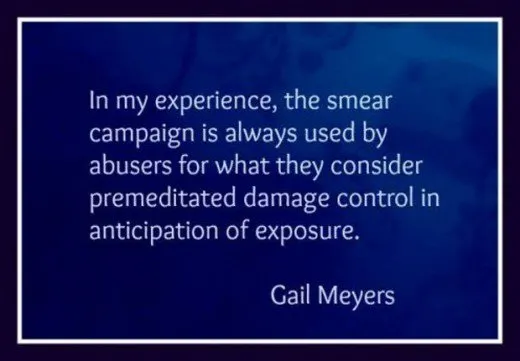
When toxic people feel threatened, they react with more manipulation and aggression. Basically, they start what is known as a smear campaign. They call their enablers to action through more lies, negativity, and exaggerations about their targets. They ramp up their alleged role of victim in their twisted game where they are, in fact, anything but victims. And their enablers naively jump to their defence and (in their minds) heroically rescue them from such horrible behaviour. Most of the time, enablers and flying monkeys don’t even attempt to hear anyone else’s side of the story. They flat out believe the nonsense they’re being fed. In my experience, some enablers will also return to scapegoating the narcissist’s target simply to bring an end to the ranting and raging. What they truly believe is anyone’s guess; their goal is simply to find a (usually temporary) reprieve from the toxic person’s thunderstorm. Overall, though, toxic people will pull out all the stops in an effort to maintain their control and position within their environment. Those false narratives are the very foundation of the protection of their egos. If they couldn’t triangulate and place blame on others, then they might ultimately be asked by their enablers to face accountability or, even worse, be forced to honestly evaluate themselves and engage in introspection. To a narcissist or other toxic individual, that would be a fate worse than death.

So if we’re the scapegoat and we recognize, based on the behaviour of others, that the narcissist/toxic person in our life has been frantically pumping those bellows and turning up the heat against us, even though we’re typically left in the dark as to what has been said, what can we do? Well, that varies by individual. One method that people find useful is to not JADE; that is, don’t Justify, Argue, Defend, or Explain. Yes, that’s a challenging task. No one wants to have lies floating around about them, and it’s human nature to want to JADE. But another more viable option is to simply live our lives and let our behaviour speak for itself. And in all honesty, silence speaks volumes, people. It truly does. There will always be enablers and flying monkeys. That’s just a fact of life. It lies with us to decide how much we will allow those dynamics to create negative personal impacts for us. Yet another option is to learn to let go of or distance ourselves from people who don’t see us as we truly are, but, rather, choose to believe the tales being spun about us by toxic people who are all about being in control and actively working to destroy relationships that they feel threatened by. Even though it’s easy to feel trapped within toxic systems, and we’ve often been trained to feel that we’re permanently stuck, helpless, and lacking any control over our own lives, we do have choices as to how we react to toxicity and dysfunction being aimed at us. We truly do have power. Remembering that fact and feeling empowered by it is half the battle.

Until next time,

Heather ~Natural Clarity Coaching~ naturalclaritycoaching.com na********************@***il.com Natural Clarity Coaching on Facebook, Instagram, LinkedIn, and Twitter

They make it about you because it can’t be about them

It’s intriguing how narcissistically-inclined individuals refuse to take the blame for anything, even when everyone involved is aware that they are clearly at fault. Definitely a case of ego protection. Fragile egos cannot withstand being wrong…ever. And one of the best add-ons to refusing to take the blame is often putting that blame onto others.

Using family as an example, if we happen to be the scapegoat, that makes us the ongoing target of narcissists or other toxic people who need to shift the direction in which fingers are pointing. Plus, it’s easy for a dysfunctional family to accept without question that the designated scapegoat is the problem, even without any evidence or so much as asking for their perspective on the matter at hand. This could also happen in the workplace, social situations, or other environments.

So the next time that you are blamed for something you didn’t do, say, or whatever the accusation entails, consider the source. Is this someone with a fragile ego? Have you thought of them being narcissistic in nature? Do they have to be ‘right’ at all costs in order to continue their mask of perfection? Have they dragged you into it as a scapegoat for their own behaviour? Or is this person a flying monkey, acting on behalf of a narcissist who’s trying to shift blame? If so, stay strong. Take the emotion out and consider the mechanics of it. When you look at the situation from a neutral state, it’s much less complicated to approach. Avoiding JADE-ing – Justify, Argue, Defend, Explain – will also be useful. None of that is necessary. Walk away if you can. Say as little as possible. Don’t engage with the blame projector or anyone who is encouraging or furthering their accusations. Hold your head high. People (particularly flying monkeys) will believe what they want to believe, no matter what we say or do. Know that this has nothing to do with you and you owe no one any explanations or apologies. If you absolutely need to speak for yourself, stick to the facts and leave that emotional component out of it.

And remember, they make it about you because they literally aren’t strong enough for it to be about them. They can’t be wrong. They refuse to be accountable as a result. This is a disordered person and, usually, their merry band of enablers on the sidelines. No amount of explaining, putting forward evidence, or pointing the finger will improve the situation. Narcissists and assorted other toxic people will not back down, especially if it involves their egos taking a hit. It helps to focus on being grateful that you don’t need to live your life like that. Think about how much energy is required to behave in that fashion and continually find ways to protect against any hits to the ego. Leave them to their devices and move forward. It isn’t easy to be blamed for other people’s actions. But accepting the blame is an entirely different aspect. Just because someone says it, doesn’t make it true, nor does it mean we need to accept it. Know yourself and stay loyal to who you are, regardless of whatever chaos may be swirling around.

Trust me when I say that the more you practice leaving the emotion out of interactions with narcissists or their supporters, the easier it gets to stay calm and not be affected by their behaviour. This leads to improved awareness and empowerment, which allows us the tools to avoid being trapped in the future webs of narcissists. Stay strong and aware, my friends! We’ve got this!

Until next time,

Heather ~Natural Clarity Coaching~ naturalclaritycoaching.com na********************@***il.com Natural Clarity Coaching on Facebook, Instagram, LinkedIn, and Twitter

Life as the Family Scapegoat

From the perspective of an ACON (Adult Children of Narcissists) and a DONM (Daughters of Narcissistic Mothers), I could literally write a book on my experiences. In all honesty, anyone who grew up in a disordered household headed by a narcissist will have innumerable stories they could tell. The tales we can tell are our own but, sadly, the majority of them are incredibly similar at their root level. They all generally boil down to narcissistic behaviours and how they domino out to everyone in their orbit.

If I were to go to a more personal level and summarize my life as the child of a narcissist into its most basic form by using a few examples, it would be this:

As the family scapegoat, I felt from a very early age that my mom and I simply didn’t ‘jive’. The connection just wasn’t there. Being female, and through no fault of my own (from stories recounted to me, this appears to have started when I was just a baby – for example, being told many times over the course of my life that she wanted to throw me against a wall because I cried when I had colic), I triggered her own deep-seated issues, which caused her to target me and resulted in a lack of a bond between us. This woman adores, supports, encourages, brags about and idolizes my younger brother. It’s not as though she is incapable of those things. Ironically enough, when he and I have made similar decisions in our lives as adults, she has raved about how wondrous his choices were but somehow managed to find fault with all of mine. Although this narcissistic behaviour became abundantly clear to me many years ago, it was incredibly confusing when I was younger, and led to me accepting her nonsense and losing any self-esteem or confidence I may have had. This was my mother. My dad went along with it. I believed her to be the all-knowing and wise person she claimed to be. If she deemed me a disappointment and a failure, then she was probably right as far as I was concerned. That’s what narcissistic abuse has the potential to do to a person when they don’t have a knowledgeable support system or awareness to lean on.

Throughout my childhood and into my teen years, I was pressured and expected to excel at everything I did while, simultaneously, a cloud of low expectations hung over my head. My mom expected me to be the best (because in her mind this would make her look good to the outside world) while at the same time telling me I was “just average” (she’s big on labelling, especially when it comes to intelligence). To add insult to injury, no matter how well I did in school or other pursuits, it was never good enough for her. An ‘A’ on a test would result in her questioning why it wasn’t an A+. On occasions when an A+ was awarded, apparently it was obvious to my mom that the test was too easy and likely everyone in the class did well on it. Or sometimes she surmised that the teacher must have favored me and therefore the mark wasn’t truly representative of my (in her opinion, limited) abilities and was undeserved and, in fact, unfair to my classmates. The same judgments were a constant for any of my other pursuits, including sports and, especially, music. She always heard that one little mistake and, in her opinion, that ruined the entire performance. That one error would be blown out of proportion and zero credit would be given for the thousands of correct notes and other musical elements that go together with them. Looking back from an adult’s point of view, I realized that from a young age I began focusing on the negative and not looking at my strengths as a direct result of my mother’s constant judgments and criticisms as well as the almost complete lack of encouragement and support. One mistake became catastrophic in my mind.

My friends were also constantly being critiqued and negative comments made to me about them. In her mind, I never chose the ‘right’ friends (or partners as I got older). She would literally suggest the people that I should spend time with (people she felt would be “good friends”) and would badger me about it on a regular basis. There would be comments made by her that my chosen friends were abusive (ironic, isn’t it?!) and that I needed to “get a backbone” and “stand up” for myself. One time when I had a falling out (temporary, thankfully) with a friend (which, by the way, was instigated by my mom and her constant prodding), I shared with my mom just how upset I was that I felt I had lost my best friend. Rather than comfort me or say something supportive, she started crying and told me that she thought she was my best friend and that what I said had hurt her deeply! Within a couple weeks, though, she was talking about how many years she and her “best friend” had known one another!

One moment that is very vivid for me after many years was the time that I told my mom that I was feeling depressed. After getting this out in the open, I started to cry because I was feeling emotional. She slapped me across the face, told me to “snap out of it” and then stormed out of the room, slamming the door behind her. Needless to say, that was truly a lesson in not sharing my feelings that has stuck with me since then. Working through it has been a process but is well worth it.

In terms of my family of origin (FOO), it was dysfunctional from day one. My dad, bless his heart, is a lovely man who is loyal and kind to a fault. Does he see my mom for who she is? I don’t know for certain. I’ve seen glimpses of awareness over the years but his enabling behaviour continues regardless. However, I do understand the reason for this. My mom has a strong “you’re either with me or against me” mentality with everyone in her life. If my dad even slightly appears to side with anyone but her, days or sometimes weeks of misery rain down upon him. Her vicious griping is equally as undesirable as her cold stares and silent treatment. I don’t blame him for wanting to avoid all of that. I get it because I’ve lived it, too. He has spent decades working/escaping more than he was home so I’m sure it’s nice to look forward to downtime rather than dreading it. But it’s also really difficult for me to have always been the scapegoat (my golden child sibling was, of course, rarely held accountable for anything), the black sheep, the one “in the wrong” no matter what, the one whose perspective was not allowed to be heard. As an aside, I had an absolutely wonderful grandmother who lived nearby who was supportive, loving, caring and an amazing friend. Without her … well, I wouldn’t even want to imagine how much more challenging life would have been. Although we rarely spoke of my mom or her behaviour (it’s quite likely that she had never put a name to it, and she was also someone who didn’t speak of others behind their backs), my grandma was there for me and that was what mattered.

Fittingly enough, the final narcissistic straw for me that led to many and continuing years of low and rare contact (never in-person or by phone) with my parents was, after several months of ridiculous drama, my mom pressuring my dad to the point where he informed me that I had “been the problem in this family for XX years” (the X’s represent my age at the time). Yes, folks, apparently my just being born was an issue and, in fact, the very reason our family was so disordered. After all that, I was then informed by my mom that my dad wouldn’t have said that (it was said in front of a witness) and that I needed to apologize. And that situation from start to finish is something that really sealed the deal for me in recognizing that I genuinely was not and had never been “the problem” in my family, no matter how much my narcissistic mother needed to label me as such in order to avoid dealing with or having other people focus on her many serious issues and the trouble those had caused within our family unit. Before I could walk, talk or be independent enough to even cause a problem for anyone, I was negatively labelled and that continued on because my mom needed it to and my dad felt that he was required to go along with it or else be made miserable (yes, he had choices but his blind loyalty and trying to protect his own peace traditionally came and still comes first). And then to be be informed that I had made up my dad’s words to me and should apologize … well, that was added to the already large stores of strong evidence that my mom holds neither herself (I don’t recall her ever sincerely accepting responsibility for her actions or giving a genuine apology for anything) nor anyone who acts on her behalf accountable for anything. Shifting the blame is typical behaviour, particularly blaming the family scapegoat.

So, obviously this is an incredibly shortened version of a small number of my experiences within a narcissistic family. There are hundreds, maybe thousands more that I could write about but it would take me well beyond the scope of a website post. Since becoming aware of my mother’s issues, how it impacted my family of origin, and how it has deeply affected me on more levels than I ever thought possible, I have read, researched and taken in everything possible on the subject of narcissism and its far-reaching impacts. I have worked diligently on my own recovery and committed years ago to helping and supporting others in doing the same. I also firmly believe in educating people in the realm of narcissism awareness so that some might be spared from being victims of the damage caused by individuals with this personality disorder. Difficult as they were, my experiences have made me the person I am today and also placed me in the position of being there to help others who find themselves in the grips of narcissistic abuse and/or attempting to recover from it.

Until next time,

Heather Natural Clarity Coaching naturalclaritycoaching.com na********************@***il.com Natural Clarity Coaching on Facebook, Instagram, LinkedIn and Twitter

Tactics used by Narcissists to control and/or silence others – Part 2

So continuing on from Part 1 of this topic of the tactics used by narcissists in order to control and/or silence others, here are some further items:

Nitpicking and Constantly Changing the Rules – Narcissists are renowned for nitpicking their targets. They will complain about anything and everything about you and your behaviour, right down to the smallest of details. It’s a constant barrage of judgments and criticisms. You’re damned if you do and damned if you don’t. It feels like a perpetual storm cloud over your head. In terms of constantly changing the rules, no matter how much proof is provided or action is taken on your part to meet whatever expectations the narcissistic individual has created, they will continue to demand more proof and also set up new expectations (moving the goalposts). There’s definitely no winning in this situation. How to stay strong: Ensure that you validate and approve of yourself despite what you’re hearing from the narcissist. Try to spend time with people who are positive and kind.

Avoiding Accountability by Changing the Subject – Narcissists are professionals at making subject changes in order to avoid accepting accountability for their actions and behaviour. Typically these subject changes involve making you and all of your alleged flaws the topic of the conversation instead. Accountability for a narcissist equates to damaging their ego and they will do pretty much anything to avoid that scenario. How to stay strong: If you feel that you need to have this discussion, one technique is to continue to redirect the narcissist to the facts at hand. If it isn’t worth it to continue trying to make them accountable, simply disengage.

Name-Calling, Sarcasm, Condescension, Shaming, Insults Disguised as Jokes, and Covert and Overt Threats – When a narcissistic person is not getting their way in the form of controlling and/or silencing you, they will quite often resort to name-calling. The tactic here involves intimidating and belittling you into submission as well as breaking down your confidence and willingness to stand up for yourself. Narcissists will also say something offensive and insulting and then, if you call them out on it, they will claim they were ‘only joking’ and that you need to not be so sensitive and learn to recognize a joke. These dysfunctional people will also use sarcasm, condescension and shaming in very passive-aggressive ways in order to get their message across without being direct about it (which leaves their targets wondering if they truly are ‘taking things the wrong way’). In terms of threats, both covert and overt, these can arise out of a difference of opinion or as a result of your implementation or continued enforcement of boundaries. Again, this is meant to intimidate you into silence and/or compliance with the narcissist’s many rules. How to stay strong: The best response to name-calling, insults veiled as jokes, etc., and/or threats is to put a quick end to the interaction and make it clear that you won’t tolerate intimidation, bullying and disrespect. Then try to ensure that you don’t internalize any of the nonsense that was spewed at you. It’s all fiction and absolutely without substance or truth. None of it is about you; it’s all about the disordered individual and their many issues.

Baiting You and Then Feigning Innocence – A regular ploy used by most narcissists is to bait you (they love starting drama and get bored without it!) and then feign innocence. This involves doing or saying something that they know will hurt or upset you and then when you react, they behave as though they don’t know what you’re going on about plus you’ve victimized them in the bargain. “I didn’t mean anything by that. What are you talking about? How could you even think that of me? You’re such a mean person”. And just like that, they’ve upset/hurt you, made it seem like your over-sensitivity and paranoia caused you to get upset over nothing, and then you allegedly went on to victimize them when they did absolutely nothing to attract your wrath. Tripple-whammy! How to stay strong: One of the tricks to coping with this tactic is to not allow yourself to be baited in the first place. Once you become accustomed to what baiting involves (once you see the specific pattern and cues, you will know what to look for every time), you can refuse to enter the arena before the game even gets started. Shut it down and move on with your day.

There are a few other tactics used by narcissists to control and/or silence their targets but the above are the main ones. Narcissists need to control the people around them in order to maintain their ego-protecting bubble and never have to face accountability for their toddler-like and negative behaviour. If they can’t control someone in their environment, then their next step is to attempt to silence them. As I mentioned in Part 1, the best thing we can do is to educate ourselves on these tactics, learn to recognize them no matter what attempts are made to disguise them, take steps to remove or protect ourselves from these strategies (picturing yourself covered in bubble wrap that keeps the narcissist’s negativity from accessing you is a great use of imagery for strength and protection), and then ensure that we don’t allow any of it to damage our self-esteem or personal peace. If we keep in mind that the behaviours of narcissists have nothing to do with anyone but them and we learn not to personalize it, it can make a major difference in our lives and wellbeing. Knowledge is power and this is particularly true in these situations. And be aware that low contact or no contact with toxic people are always options at any point in time for any type of relationship. Stay strong!

Until next time,

Heather ~Natural Clarity Coaching~ www.naturalclaritycoaching.com na********************@***il.com Natural Clarity Coaching on Facebook, Instagram and Twitter

Tactics used by Narcissists to control and/or silence others – Part 1

Narcissists use a variety of tactics to get what they want, including control over or silencing others. Here are just a few of the main tactics together with ways to combat them.

Projection – Narcissists refuse to see their own shortcomings because it damages their already fragile egos. As a result, they will accuse others of their own traits and behaviours in order to displace these things from themselves. How to stay strong: Don’t project your good traits onto the narcissist (expecting them to be like you is dangerous and will be disappointing), and don’t accept their negative ones as your own.

Gaslighting – This is a technique used by narcissists to cause distortion and erosion of other people’s sense of reality. They will suggest that an event didn’t happen or that it was all a figment of someone’s imagination and so on. Eventually, people who are gaslighted regularly will begin to question themselves and their sanity. How to stay strong: Make a point of grounding yourself in your own reality. It helps to keep a journal or discuss things with friends or members of a support group.

Ridiculous Conversations – Narcissists love to argue and it often turns a conversation into complete and utter nonsense. At the root of it, these people are arguing with themselves, not you. How to stay strong: A good option is to cut the conversation short and walk away.

All or Nothing/Black and White Thinking and Generalizations – “You never do anything right”. “You always make me angry”. “That group of people are always a problem”. Narcissistically-inclined individuals make blanket statements and far-reaching generalizations about anyone and everyone. How to stay strong: Try not to engage. Walk away wherever possible.

Making Other People’s Thoughts and Feelings Appear Absurd to Invalidate Their Rights to Have Them – If a narcissist can make someone believe that their feelings and thoughts are crazy and absurd, they can eventually wear them down until they believe they aren’t deserving of those things. How to stay strong: Again, try to stay grounded in your own reality and recognize that your feelings and thoughts are relevant and important.

Triangulation – I have written previous posts on the subject of triangulation. Triangulation involves a narcissist who won’t deal directly with someone but instead brings in a third party to do their dirty work for them, thus forming a triangle. How to stay strong: If you feel you need to respond to a third party acting on behalf of a narcissist, try to keep it short and to the point. Historically, the less you engage, the better it will be for you.

Smear Campaigns, Stalking – I have also written posts on smear campaigns in the past. This is a situation in which a narcissist targets you by speaking ill of you as an alleged aggressor while making themselves appear to be the victim, and they will spew their lies to anyone who is willing to listen, including your partners, children, friends, coworkers, relatives and so on. The narcissist may also stalk you in-person or online in order to find information with which to begin new attacks against you. How to stay strong: Again, a less-is-better approach is typically beneficial. If people confront you about your supposed negative behaviour towards a narcissist, a short “There are two sides to every story” or “If you knew me, you would know better” or something similar can be helpful. Silence is another option. Eventually, most people figure out that the person who launched the smear campaign against you is a narcissist and not to be believed.

I will move on to Part 2 on this subject of manipulative tactics to silence people in a future post. In the meantime, I recommend that everyone be aware of these tactics so as to (hopefully) not fall prey to them. When we educate ourselves regarding narcissistic behaviour, we give ourselves the tools to recognize and stay safe from their disordered actions.

Until next time,

Heather ~Natural Clarity Coaching~ www.naturalclaritycoaching.com na********************@***il.com Natural Clarity Coaching on Facebook, Instagram and Twitter

Narcissists and accountability – like oil and water

Lack of accountability is a major element of narcissism. Why? Because being accountable, in the mind of the narcissist, is tantamount to being ‘wrong’ or ‘imperfect’, which would likely damage their fragile ego. As a result, accountability is not part of their vocabulary when it comes to themselves. Everyone around them, though, is required to be highly accountable for absolutely everything, including the mistakes of the narcissist.

If it isn’t positive, the narcissist wants NOTHING to do with it. Like oil and water, narcissists and accountability don’t mix. In their mind, any negative issue has to be attributable to someone else’s weakness, error or problem. As noted above, at its very root, accountability doesn’t work for narcissists because being ‘wrong’ in the eyes of others or themselves would be too damaging to the ego that they spend every waking moment trying to protect. This is one of the most basic foundations on which narcissism operates. They will deflect being accountable like it might mortally wound them if they don’t. They will outright lie, pass blame, make false accusations, throw a fit; whatever they need to do to push away accountability, they’re usually ready and willing to do so.

Keeping this in mind when dealing with someone you feel may be a narcissist is a very helpful tool. Once you’ve learned to see through all of the deflections and fabrications, you will notice that ego is virtually always behind lack of accountability for something that is clearly attributable to the individual in question. How or if we challenge them on it goes on a case-by-case basis, but ensuring that we don’t accept blame for actions that don’t belong to us helps to avoid future self-esteem issues.

Until next time,

Heather ~Natural Clarity Coaching~ www.naturalclaritycoaching.com na********************@***il.com Natural Clarity Coaching on Facebook, Instagram and Twitter