Tag: support system (Page 2 of 6)

Let it RAIN

Hello All,

Thanks for being here. 🙂

RAIN is an acronym for a healing, meditative system for mindfulness and compassion regarding behaviours and thoughts that might be rooted in fear or other feelings. It stands for Recognize, Allow, Investigate, Nurture. This is especially beneficial for those who are survivors of narcissistic abuse or other dysfunctional relationships because it is a gentle process that can be carried out alone and at any choice of pace.

The way it works is simple. We may at some point become aware, to whatever degree, of patterns of behaviour and thoughts that we are engaging in.  There could be a catalyst that brings us to this awareness. Maybe we just had a massive blow-up with our partner or a friend. Maybe we always feel like a failure despite clear evidence to the contrary. It could be anything, or nothing at all. We may have simply arrived at this point of awareness and we’re ready to look more deeply at it. From here, we begin to recognize what might be happening. We are acknowledging  that something is negatively affecting us. And we need to ask ourselves some questions from a non-judgmental state. Are we trying to control everything; to micromanage ourselves and others? Are we unintentionally harming ourselves or important relationships with others through challenging behaviours that also affect them? These are just a couple of questions we may ask ourselves but it will all depend on what we are doing and thinking, and in what context.  This doesn’t need to be a full-blown self-inquiry. It can look like quiet but intentional thoughts or even a whisper.

The next step is to allow ourselves this state of recognition, without trying to understand it or label it. Just sit peacefully with it, in the absence of judgement or blame.  This is somewhat of a purposeful pause in order to allow for deeper levels of attention.  Fear might be showing itself. Anxiety may be hovering. We can allow ourselves to quietly observe anything that arises and acknowledge its presence within ourselves or certain situations.

Next is the investigative phase. Here, we can move on to investigating more about why we might be engaging in certain behaviours that may be causing issues for us. This is an opportunity for us to listen to our body and what it might be feeling. As the saying goes, “the issues are in our tissues”. Our bodies hold a record of our thoughts and emotions, good and bad. For example, is there tightness or discomfort in certain areas? If so, what do you think might be behind this; fear, anxiety, anger, hurt? Then ask a few simple questions. What is it that we believe about ourselves or situations that results in patterns of certain thoughts and behaviours that are not beneficial? Do we do “fill in the blank” out of fear? Are we concerned about losing control and having our worst fears come to fruition? Do we have childhood trauma from toxic role models and so we unconsciously act on messages that were unjustifiably funnelled to us as children, such as inadequacy, that we’re unlovable, abandonment, rejection, fear, and so on? Do we project unresolved, fear-based feelings from past experiences and relationships onto current relationships, inadvertently causing conflict in the present?

Lastly, we move to the nurturing process of the RAIN system. Here is the space where we show ourselves compassion and love after recognizing that we are suffering in some way. We need to ask our inner selves what is needed. Is it reassurance? Is it forgiveness? Is it engaging more in connections with others?  Then we actively provide that care to ourselves. “You’re okay.” “This isn’t your fault”. “Trust yourself”. “It’s okay to reach out for connection”.

After the four RAIN steps have been completed, it’s important to simply feel our own presence and awareness. Hold onto that meditative state for as long as you need to. We don’t need to self-limit ourselves and our lives because of fear or other heavy feelings. We can seek them out within ourselves, sit with the new awareness, acknowledge our thoughts, feelings, and behaviours, and then nurture ourselves. In this process, we have the potential to move to new and improved spaces in our lives through self-acceptance, understanding, and compassion.

Until next time,

Heather ~Natural Clarity Coaching~ naturalclaritycoaching.com na********************@***il.com Natural Clarity Coaching on Facebook, Instagram, LinkedIn, TikTok, and Twitter

References
Brach, T. (2020, January 1). RAIN: A practice of radical compassion. Tara Brach. https://www.tarabrach.com/rain-practice-radical-compassion/


Trust

A warm welcome to the new visitors to the site!  I love Google Analytics for providing insight into website activities.

So, one topic that presents challenges for scapegoats is trust. When we’re treated as a scapegoat and/or abused by narcissists, whether it’s in a family or other relationship, it damages our ability to trust others. Here we are being treated unfairly by someone who’s supposed to love and care about us, but they use us as a patsy for their own behaviour. And they criticize, berate, and lie about us all for their own interests. Sometimes physical or other abuse is involved. There’s no loyalty coming from them to us. None. If it’s a parent, we may believe that their actions toward us are somehow justified. I mean, this is our parent.  A supposed role model. Someone we should be able to trust and lean on. Someone who demands to be seen as wise and all-knowing. And yet the person they portray us to be is not anything like who we feel we are. That creates a great deal of dissonance. Then, because we’ve been taught to respect this person and “do as we’re told”, we feel guilty for even questioning them in our minds. And they will be quite willing to pile more guilt on just to keep us held down. Their behaviour towards us  – control, manipulation, gaslighting, projecting, etc. – is all meant to keep us in line and under their thumb.  They may try to mask it as concern, love, discipline, or whatever else, but it’s all about keeping us firmly entrenched in our scapegoat role.

If we go on to other relationships with narcissists (which is quite common because it’s familiar), this cycle will continue. Abuse, blame, guilt. At some point, it’s only human to want to stop trusting people, unless we’re fortunate enough to have people in our lives who happen to be the real deal and wouldn’t hurt us for all the money in the world.  There’s only so much our psyches can take before we need to protect ourselves.  That’s perfectly normal. Upsetting, but normal.

How do we learn to trust people? One big piece of advice is to take your time when we’re getting to know new people. And when it comes to people who have proved to us over and over that they can’t be trusted, but they’re suddenly saying they’ve ‘changed’, we need to keep their past behaviour in mind before we let down our guard.  There truly are good people out there in the world. We just need to listen to our intuition and past experience. We need to trust ourselves and our ability to make good judgments. And if red flags turn up along the way, we have every right to remove ourselves from whatever the situation may be. Don’t worry about hurt feelings or someone getting peeved.  We need to take care of ourselves, and that includes protection from people who we feel may hurt us.

In childhood, we don’t often have protection from a narcissistic parent. Family members and other relatives tend to go along with the narrative. But we may luck out and have at least one family member who’s in our corner for support, even if they do so out of sight of the narcissist. If not, we may have friends we can turn to for support. In other relationships, we may believe that the ‘love’ we were given by a narcissist is what love should look like.  As a result, we may inadvertently end up with more narcissists. And that’s okay. We all learn as we go. Once we recognize toxic people, abuse, cycles, patterns, scapegoating, and so on, we can forgive ourselves for not recognizing it because it was all we knew and what we thought was ‘normal’. And then we can do our best to keep ourselves safe from that point forward. We may at some point be tricked by another toxic person, even when we thought we had a handle on knowing what to look for. That’s okay. We forgive ourselves again and we move on. We save our trust for people who deserve it.

Yes, being a scapegoat is a difficult experience.  Look at it this way, though – imagine being a narcissist or other toxic, miserable type of person. Having to control and manipulate others just to feel some sense of security. Protecting a fragile ego at all costs. Hurting people over and over again. No, thanks! Even though they hurt us, at least we can learn, grow, and become stronger, kinder people.  They also provide us with a spectacular model of who we don’t ever want to be. They’re absolutely stuck where they are. Very few toxic people ever change. We have so many opportunities for changing and adapting. That’s such a gift.

Until next time,

Heather ~Natural Clarity Coaching~ naturalclaritycoaching.com na********************@***il.com Natural Clarity Coaching on Facebook, Instagram, LinkedIn, TikTok, and Twitter


Scapegoats/Black Sheep are often Truth-Tellers

In many cases within a dysfunctional family system, the individual who is silently labelled as the scapegoat or black sheep will be a truth-teller.  By this, I mean someone who tells their truth at any cost, even when it comes to the dysfunctions of their family of origin or a close relationship with a partner or friend.

Given that narcissists, for example, create their own self-serving realities and expect everyone to accept them without question, a truth-teller is an aggravation to them.  This may be one of the reasons why the scapegoat or black sheep was targeted in the first place.  Who better to hold accountable for all the family’s or relationship’s problems than someone who has the power to blow the whistle on the entire system?  So the scapegoat is perpetually discredited and made to look like a liar, or even “crazy”, in order to protect the narcissist’s (or other toxic person’s) carefully crafted persona and to carry on the family or relationship roles and systems.

I say, embrace truth-telling.  There will always be people who dislike the truth because it doesn’t fit their narrative.  So be it.  It isn’t the end of the world.  Over time, many of us who are scapegoated, black sheep, truth-tellers eventually separate ourselves from our toxic family of origin (or other relationships in our lives) because we realize that no matter what we say or do to simply be ourselves or defend ourselves, those dynamics will continue.  As long as we continue to speak our truth, we will be targeted, blamed, and have smear campaigns launched against us by some people.

In the end, we need to be true to ourselves.  And that includes being truth-tellers and often means going no contact or low contact with certain people.  Is that challenging?  It definitely can be.  Is it impossible?  Nope.  And, in my experience, it will bring more peace and calm into daily life than was ever experienced in the past.   That’s worth its weight in gold.

Don’t be afraid to be a truth-teller.  And just know that if someone doesn’t like hearing your truth, especially about dysfunctional family or relationship systems, it’s probably because they feel threatened by it.  That’s their issue, not yours.  And don’t forget about self-care if you’re in the midst of challenges.  Here’s a great book that you might want to consider for ideas: https://amzn.to/3n2B92Y. (Just copy and paste the link into your browser and it will direct you to the book.)

Until next time,

Heather ~Natural Clarity Coaching~ naturalclaritycoaching.com na********************@***il.com Natural Clarity Coaching on Facebook, Instagram, LinkedIn, TikTok, and Twitter

Attachment in a Dysfunctional Family

Hi All,

I thought it might be beneficial to write a post about attachment within dysfunctional families, particularly with narcissists.

Attachment theory is based in psychology and looks at the relationship between a primary caregiver and their baby.  There are different stages of attachment, moving from birth to around two years of age.  Although there are four defined styles of attachment, both avoidant and dismissive attachment are the most common for children of narcissists.  These are insecure attachments, as compared to secure attachment with caregivers on which a child can depend.

Avoidant attachment involves a style of the child showing absolutely no preference for their caregiver or a complete stranger.  Often, this is created by caregivers who are neglectful and/or abusive.

Disorganized attachment looks like a mixture of behaviour, seeming at times confused or disoriented.  Due to caregivers who have made a child fearful of them, this style can result in the desire to defend oneself while still wanting to reach out to and form attachments with others.

Beyond the age of two, avoidant attachment often includes avoidance of seeking help from others because the individual needed to learn to be independent when their caregiver was never there for them.  Disorganized attachment individuals may display disassociation and/or symptoms of PTSD.

As adults, these attachment patterns, which formed at a young age, stay with us.  This often results in the recreation of these attachment/relationship styles throughout our lives, particularly in romantic interactions.  They shape how we see ourselves and others.

With insecure attachments, we may have more stress hormones, negative self-perception, and difficulties with emotions, cognition, and behaviour.  Anxiety, depression, and PTSD are also common outcomes.

So, where does this leave us?  When we become aware of these attachment styles and how they can impact us on many levels, we can learn to get out in front of them.  We can change our perspectives and perceptions.  We have the power and the tools to overcome these patterns.  Two of the main things we need are awareness and a desire to improve our situation.  Stop and think when an automatic response to a situation arises within: why is it that I’m feeling this way?  Is it a lifetime habit based in my childhood?  Is there another, more positive and healthy reaction that could be chosen?  What are the actual feelings at play here, rather than habitual reactions?

There is hope.  It can and does get better.  Here’s a link to a book on the subject: https://amzn.to/3JcVfid.

Until next time,

Heather ~Natural Clarity Coaching~ naturalclaritycoaching.com na********************@***il.com Natural Clarity Coaching on Facebook, Instagram, LinkedIn, TikTok, and Twitter


Separation and Divorce

Both separation and divorce are difficult experiences.  This can be particularly true when dealing with a toxic person.  Narcissists are often the main cause of many relationship breakdowns, although you’d never hear them taking ownership of their part in it.  And they can make it more challenging when children are involved.

We may find ourselves questioning how we ended up with a narcissist or other toxic person in the first place.  In some cases, if we have toxic role models in our lives, they have likely taught us a very skewed version of love.  In actuality, it isn’t love, but as children, we have no way of knowing that.  If we call a spade a spade, it’s control, manipulation, and abuse masquerading as what we’re expected to accept as “love”.  For others, it may be that we grew up in a loving, functional, and healthy family but we meet a person who does a good job of pretending to be someone they’re not, until they get us where they want us.  That place may be marriage, shared debt, children, or a multitude of other things that bind us to them and make it harder for us to walk away.

Regardless of how we’ve ended up with toxic people, if we eventually find our way to the point of leaving, we can use all the support we can get.  Unfortunately, when our family of origin is dysfunctional, we’re unlikely to receive any authentic support from them.  In fact, they may even make the whole situation feel even worse.  For many, it’s also common to have feelings of embarrassment or shame coming into the picture, so they don’t want to turn to anyone, even healthy family and friends.

If you’re going through separation or divorce, or in the phases leading to it, reach out for support.  When you are fortunate to have loving people in your life, consider talking to them about your situation.  You might be surprised just how much it can help to have people behind you who understand what you’re going through.  And, honestly, there’s no shame or reason to be embarrassed about leaving an unhealthy relationship.  We all have our limits, and only we can decide when it’s time to close a chapter in our lives.  But we don’t need to be martyrs and hang on, especially if it’s to avoid judgment by others.  Let people judge.  That’s their problem, not ours.

And when we don’t have anyone we feel we can to turn to on a personal level, it may be time to seek out other resources.   This could be online or in-person support groups, counselling or coaching, or reading or watching videos about the various parts of relationship breakdown and how to cope.  As a side note, find legal resources to protect yourself on that front as well.  If you can’t afford a lawyer, search for resources that can be of assistance.  Find that light at the end of the tunnel.  Trust me, it’s there.

With coaching, there is someone available to hear you, to help guide you towards a new chapter with courage andempowerment, and to assist you in taking a deep dive into what you want your future to look like, no matter where you’re at in life.  Check in with this website often, as there will be new online programs being released in the upcoming months that you might find helpful.

Just know, it does get better.  We grow through what we go through.  Even though these situations can make us feel weak and lost, we typically come out of them feeling stronger and more focused.

Until next time,

Heather ~Natural Clarity Coaching~ naturalclaritycoaching.com na********************@***il.com Natural Clarity Coaching on Facebook, Instagram, LinkedIn, and Twitter

New Online Program Being Created

Hi All,

Hope this finds you well.  Thanks to everyone who has recently joined the mailing list and to the increasing numbers of people who are touching down on the website.

Just letting you know that I’m working on a new program to be offered online.  I’ll post an announcement once it’s up and running.  I think it will be a beneficial program, and I’m looking forward to launching it in the next few months.

Until next time,

Heather ~Natural Clarity Coaching~ naturalclaritycoaching.com na********************@***il.com Natural Clarity Coaching on Facebook, Instagram, LinkedIn, and Twitter


Happy Holidays!

To all of the visitors to this website, thank you for stopping by!  And to those who celebrate Christmas, I’m sending out a hearty Merry Christmas to you!  For anyone who’s struggling this holiday season, take a peek at the previous post for some tips.

Until next time,

Heather ~Natural Clarity Coaching~ naturalclaritycoaching.com na********************@***il.com Natural Clarity Coaching on Facebook, Instagram, LinkedIn, and Twitter

Emotional Loneliness in Abnormal Environments

As children in dysfunctional families, particularly with narcissists in the mix, emotional loneliness can be a strong factor in our lives.  We may feel very alone and abandoned, and, in many cases, this creates feelings of something being ‘wrong’ with us.  In turn, we may use unhealthy coping mechanisms to deal with all of it.

This emotional loneliness comes from being in an abnormal environment where sympathetic interest in us is lacking.  We may be told we’re too sensitive or too emotional.  Or the unspoken (or sometimes spoken) message might be that we don’t matter enough to our family for them to even take the time or make the effort to hear us or provide any support or comfort.  We’re usually conditioned to believe that the only voices that matter come from our caregivers and that they’re the only ones who are permitted to have and express all manner of emotions.  It’s a lonely and emotionally cut-off place to be, without a doubt.  This is abuse and it creates interpersonal trauma.

But does feeling this way mean there’s something wrong with us?  No.  Not in any way, shape, or form.  The way we feel is a completely normal reaction to an abnormal environment.  In most cases, our caregivers simply weren’t emotionally mature enough themselves, for whatever reason, to offer emotional support to anyone else.  We feel the effects of that void in the form of emotional loneliness.  It’s like being completely alone on an island.  As humans, it’s absolutely normal to feel this way in response to a lack of healthy contact and support from our caregivers.  It doesn’t mean there’s something wrong with us.  The root of these feelings is people who aren’t there for us the way they should be.  And we’re having normal human reactions to being starved of those connections and experiences.

So, how do we overcome emotional loneliness?  First of all, be aware that it won’t happen overnight, but it’s worth taking the time to heal.  We need to begin by repairing our conditioned reality.  Dysfunctional families are not there for one another in healthy and supportive ways.  If we’re looking at narcissistic parenting, for example, narcissists, with their fragile and needy egos, have zero ability or desire to attend to anyone but themselves, and they expect everyone around them to make them the center of the universe as well.  Once we see that, things begin to make sense.  “Hey, there’s nothing wrong with me!  I was reacting normally to an abnormal environment.”  Then we need to move on to the next step, which is to learn to love ourselves.  It sounds cliched, for sure.  But it helps us to heal.  This can look like building compassion for and trust in ourselves, giving ourselves the unconditional love that we deserved but rarely or never received as children, comforting and hearing our inner child, learning to silence our internal critic and the guilt and shame that has been unjustly forced on us, and exercising regular self-care.  We need to develop healthy, non-toxic relationships with self and with supportive others in order to heal ourselves.

Until next time,

Heather ~Natural Clarity Coaching~ naturalclaritycoaching.com na********************@***il.com Natural Clarity Coaching on Facebook, Instagram, LinkedIn, and Twitter

Narcissists love fanning the flames of discord, especially against scapegoats

For anyone who has had issues with a narcissist or other toxic individual, it is evident that they love to fan the flames of discord. Oh, they’ll smile and try to hide the bellows behind their back, but they’re definitely keeping that fire nice and hot when no one is looking.

When a narcissist chooses a scapegoat (or sometimes more than one), within a family, workplace, or other environment, they then need to continue the narrative against that person at all costs. Without the continuation of this false narrative they have created against their target(s), the entire system upon which they bolster their fragile ego, is at risk of collapsing. This is especially true when they feel that their control is being threatened. Some examples of this may be an enabling parent showing kindness or some other form of positivity towards a scapegoated child, or it could be a scapegoated individual in the workplace who is having a friendly chat with a “flying monkey” co-worker in the lunchroom. Narcissists in particular can’t allow those types of things to happen because it goes against the picture they’ve painted of their target, and they also don’t want to risk people having a discussion about them and discovering the truth.

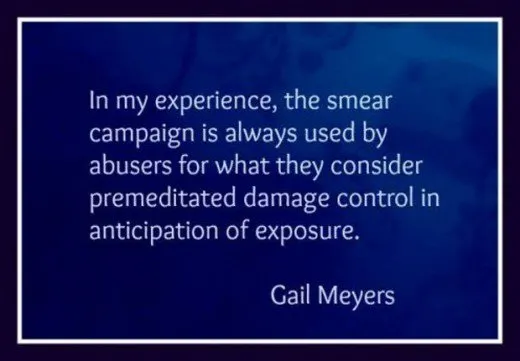
When toxic people feel threatened, they react with more manipulation and aggression. Basically, they start what is known as a smear campaign. They call their enablers to action through more lies, negativity, and exaggerations about their targets. They ramp up their alleged role of victim in their twisted game where they are, in fact, anything but victims. And their enablers naively jump to their defence and (in their minds) heroically rescue them from such horrible behaviour. Most of the time, enablers and flying monkeys don’t even attempt to hear anyone else’s side of the story. They flat out believe the nonsense they’re being fed. In my experience, some enablers will also return to scapegoating the narcissist’s target simply to bring an end to the ranting and raging. What they truly believe is anyone’s guess; their goal is simply to find a (usually temporary) reprieve from the toxic person’s thunderstorm. Overall, though, toxic people will pull out all the stops in an effort to maintain their control and position within their environment. Those false narratives are the very foundation of the protection of their egos. If they couldn’t triangulate and place blame on others, then they might ultimately be asked by their enablers to face accountability or, even worse, be forced to honestly evaluate themselves and engage in introspection. To a narcissist or other toxic individual, that would be a fate worse than death.

So if we’re the scapegoat and we recognize, based on the behaviour of others, that the narcissist/toxic person in our life has been frantically pumping those bellows and turning up the heat against us, even though we’re typically left in the dark as to what has been said, what can we do? Well, that varies by individual. One method that people find useful is to not JADE; that is, don’t Justify, Argue, Defend, or Explain. Yes, that’s a challenging task. No one wants to have lies floating around about them, and it’s human nature to want to JADE. But another more viable option is to simply live our lives and let our behaviour speak for itself. And in all honesty, silence speaks volumes, people. It truly does. There will always be enablers and flying monkeys. That’s just a fact of life. It lies with us to decide how much we will allow those dynamics to create negative personal impacts for us. Yet another option is to learn to let go of or distance ourselves from people who don’t see us as we truly are, but, rather, choose to believe the tales being spun about us by toxic people who are all about being in control and actively working to destroy relationships that they feel threatened by. Even though it’s easy to feel trapped within toxic systems, and we’ve often been trained to feel that we’re permanently stuck, helpless, and lacking any control over our own lives, we do have choices as to how we react to toxicity and dysfunction being aimed at us. We truly do have power. Remembering that fact and feeling empowered by it is half the battle.

Until next time,

Heather ~Natural Clarity Coaching~ naturalclaritycoaching.com na********************@***il.com Natural Clarity Coaching on Facebook, Instagram, LinkedIn, and Twitter

Does ‘no contact’ work?

Hi everyone. After a late-summer holiday, I started back to my university psychology studies. So I’ve been busy. But I wanted to sit down and write a post.

‘No contact’ – does it work? First of all, ‘no contact’ refers to exactly what it sounds like: not being in contact with a particular person or people. Zero interactions of any kind. In many cases, we may decide, in our own best interest, that we can’t be in touch with toxic people. So we then refrain from contacting them or accepting any form of communications from them. We can let people know this is happening in advance, or we can simply make it happen. It’s our choice how we do it.

There’s no doubt that ‘no contact’ can be very challenging to implement at first, particularly if the person or people in question have been a big part of our lives. So it’s best to be prepared for those feelings. As time passes, though, many of us find that peace begins to settle into our lives as a result of keeping ourselves safe from toxic people, and we will become increasingly protective of that peace.

To answer the original question, yes, ‘no contact’ works. So does ‘low contact’ when it’s done on our terms. But it has to be 100 % adhered to on a continual basis. And once peace has settled in, even thinking about reaching out to the person (or beyond ‘low contact’, if that’s what we’ve chosen) will be a thing of the past. Realizing our value and that we deserve respect and a peaceful existence are strong contributors to maintaining boundaries.

Lastly, it’s best not to allow feelings of guilt to get the best of us after we’ve made this decision. Flying monkeys may take a run at harassing us to reconnect with the toxic individual. The toxic person themselves may try to confront us in order to reestablish the status quo. And as people who have been targets of their abusive behaviours, we may already be programmed to quickly or even automatically believe that we’re doing something wrong and should be ashamed. Drop the programming like a bad habit and recognize that we all make our own choices and it’s okay to not want to be treated disrespectfully and abusively. And we have the right to keep people out of our lives if they aren’t good for us. No matter what we may have been told, we have the right to peace and to protect ourselves from anyone at any time.

Until next time,

Heather ~Natural Clarity Coaching~ naturalclaritycoaching.com na********************@***il.com Natural Clarity Coaching on Facebook, Instagram, LinkedIn, and Twitter

« Older posts Newer posts »