
Tag: smear campaigns

Toxic Family System – Basics Refresher

Hey there! So I thought it might be beneficial to go over dysfunctional and toxic family systems, such as is found with narcissists. This is a topic I’ve written about in the past, but I’m aware that there are always people coming to the blog who are in the beginning stages of trying to understand their situation.

Typically, there will be one narcissist at the helm of a family. Occasionally there will be two, but that’s a rarity. Why? Because narcissists generally gravitate towards partners who will make them the center of attention, and two narcissists couldn’t realistically supply each other with all of that ego-stroking. They want their ego stroked, and they aren’t interested in authentically doing that for anyone else. So partners of narcissists tend to be what is described as enablers. These individuals don’t take a stand for themselves or any children they may have with the narcissist. And they spend the majority of their time attempting to keep the peace and ensure that the narcissist is happy — at any cost. Enabling behaviour may also involve spending as little time at home as possible, leaving children entirely alone with the narcissist parent.

Next, in any narcissistic family there needs to be a scapegoat or black sheep amongst their children. In some cases, there’s more than one scapegoat. Scapegoats are chosen by the narcissist at birth or a young age (for any number of ridiculous reasons from gender to intelligence, physical traits, personality, and so on) and, at the urging of the narcissist parent, are blamed for everything by everyone in the family, including by their golden child sibling(s). There are many stories of scapegoats being told they have been the problem in their family since they were born! I know…it makes absolutely no sense, but that’s the way this dysfunctional system operates.

Golden child was made mention of in the previous paragraph. This child is also chosen by the narcissist, but for entirely different reasons than the scapegoat (yet it’s typically as senseless as the reasons behind the narcissist’s choice of a scapegoat). This golden child can do no wrong, ever. They are viewed as perfection itself by the narcissistic parent. The perfect baby, the smartest and funniest child, the most attractive teenager — you get the picture. And this adoration continues into adulthood for the golden child, while the scapegoat is unable to cast off their negative label no matter what they’ve accomplished in life.

The narcissistic family system requires everyone to play their assigned roles. The narcissist has all of the power and control over the family. The enabling parent needs to supply the narcissist with ongoing support, ego-stroking, and undying love. These enabling parents will throw their scapegoat child(ren) to the wolves time and again if it means keeping the peace between themselves and their narcissist partner. And this is because not only have they been told over and over again how ‘fill-in-the-blank-with-a-negative-word’ the scapegoat is, to the point that it’s simply accepted as fact, but if they don’t go along with the narcissist, their life is made miserable by narcissistic abuse. It is rare for an enabling parent to defend a scapegoat child for those very reasons. The golden child receives never-ending praise and is a source of great pride for the narcissist parent. And the scapegoat is the one who can never do anything right and is constantly having fingers pointed at them as the cause of all issues within the family (even though they probably haven’t done anything, or anything worth such berating).

From within this system, it’s easy for scapegoats to find themselves in other abusive relationships as they get older. When you’re told you’re always in the wrong and to blame for everyone’s problems, it’s easy to feel like that’s ‘normal’. It can be said that scapegoats often gravitate towards toxic people, and the reverse is also true. Toxic people need others to abuse and control, while scapegoats have been conditioned to follow orders and accept whatever is dished out to them. It’s an unfortunate but ideal pairing.

But once we see it — the abusive behaviour, controlling, gaslighting, unfairness —  it’s difficult to un-see it. And although it’s common to feel stuck, there are ways out of this role and, if we choose, out of these relationships. Boundaries, low contact, no contact, etc. To start, though, we can begin to heal by empowering ourselves and recognizing our value. There are posts about all of this within the Natural Clarity Coaching blog pages, and there will be more to come. Because it’s all about empowerment and healing. Feel free to drop in and read posts at any time. They were written to empower, support, and give hope.

Until next time,

Heather ~Natural Clarity Coaching~ naturalclaritycoaching.com na********************@***il.com Natural Clarity Coaching on Facebook, Instagram, LinkedIn

*Let’s all take care of this planet of ours *

The betrayal of a toxic family system

Toxic family systems bring with them SO much distress, pain, and harsh betrayal.  Here’s a few of the reasons (set in the context of a narcissistic family) for why that happens:

  1.  A narcissist is at the helm and center of the family, ruling it with brutal control, manipulation, and constant drama.  There’s virtually no peace to be found, particularly for the scapegoated child.
  2. A narcissist parent typically has an enabling parent by their side.  The enabler, in an effort to spare themselves and keep in good stead with the narcissist, will refuse to hear other perspectives, let alone protect or defend the scapegoat.  Scapegoats are left feeling alone, without a voice, and ganged up on.
  3. Scapegoats live a life filled with judgment, criticism, blame, and control.  The narcissist parent targets them on a regular basis, while the enabling parent either joins forces with the narcissist or silently stands back and watches it happen.
  4. Scapegoats are often pitted against the golden child(ren) of the family, and they are set up to lose every time.  And if they stand up for themselves regarding their dislike for competition with family members, the narcissist parent may tell them that they’re weak and/or jealous of their sibling.
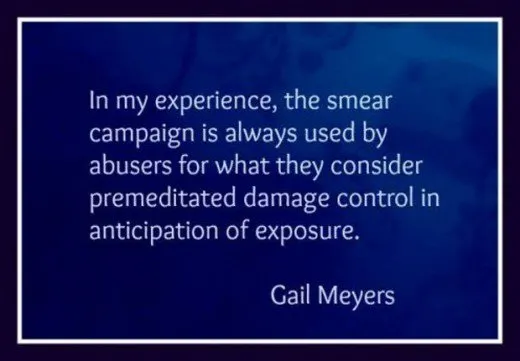
  5. When a scapegoat takes a stand, the narcissist parent will come after them in some way.  This may involve personal attacks, silent treatments, or smear campaigns.  These tactics are used by narcissists to bring people back under their control.
  6. Toxic family systems revolve around the narcissist or other disordered individual, and there is very little normalcy within this system.  The irony is that toxic people will claim that the family is “perfect” and “better than other families”, leaving scapegoats and their siblings with a skewed picture of what healthy family systems should look like.  From there, the scene is set for these individuals to go on to other dysfunctional relationships, thinking they’re ‘normal’ if they look like the system they grew up in.

Above all else, toxic families present the ultimate betrayal.  They leave members, particularly scapegoats, feeling unloved, insignificant, alone, abused, confused, bullied, useless, responsible for all that is wrong in the family, and flawed beyond hope.  And then all of these feelings and beliefs, based on the type of ‘love’ (which is not love at all) experienced in this family system, set members up to be at high risk for winding up in other toxic relationships as adults.
There is hope, though, no matter how much time has elapsed, and it starts with self-love.  Toxic family systems, through their dysfunctional dynamics and behaviours, generally teach self-loathing and self-hatred.  When we learn to love ourselves, we start on the path of setting ourselves free from the toxicity and false narratives.  We deserve peace and love, and both of those things can be created from within ourselves.

Until next time,

Heather ~Natural Clarity Coaching~ naturalclaritycoaching.com na********************@***il.com Natural Clarity Coaching on Facebook, Instagram, LinkedIn, and Twitter

Narcissists love fanning the flames of discord, especially against scapegoats

For anyone who has had issues with a narcissist or other toxic individual, it is evident that they love to fan the flames of discord. Oh, they’ll smile and try to hide the bellows behind their back, but they’re definitely keeping that fire nice and hot when no one is looking.

When a narcissist chooses a scapegoat (or sometimes more than one), within a family, workplace, or other environment, they then need to continue the narrative against that person at all costs. Without the continuation of this false narrative they have created against their target(s), the entire system upon which they bolster their fragile ego, is at risk of collapsing. This is especially true when they feel that their control is being threatened. Some examples of this may be an enabling parent showing kindness or some other form of positivity towards a scapegoated child, or it could be a scapegoated individual in the workplace who is having a friendly chat with a “flying monkey” co-worker in the lunchroom. Narcissists in particular can’t allow those types of things to happen because it goes against the picture they’ve painted of their target, and they also don’t want to risk people having a discussion about them and discovering the truth.

When toxic people feel threatened, they react with more manipulation and aggression. Basically, they start what is known as a smear campaign. They call their enablers to action through more lies, negativity, and exaggerations about their targets. They ramp up their alleged role of victim in their twisted game where they are, in fact, anything but victims. And their enablers naively jump to their defence and (in their minds) heroically rescue them from such horrible behaviour. Most of the time, enablers and flying monkeys don’t even attempt to hear anyone else’s side of the story. They flat out believe the nonsense they’re being fed. In my experience, some enablers will also return to scapegoating the narcissist’s target simply to bring an end to the ranting and raging. What they truly believe is anyone’s guess; their goal is simply to find a (usually temporary) reprieve from the toxic person’s thunderstorm. Overall, though, toxic people will pull out all the stops in an effort to maintain their control and position within their environment. Those false narratives are the very foundation of the protection of their egos. If they couldn’t triangulate and place blame on others, then they might ultimately be asked by their enablers to face accountability or, even worse, be forced to honestly evaluate themselves and engage in introspection. To a narcissist or other toxic individual, that would be a fate worse than death.

So if we’re the scapegoat and we recognize, based on the behaviour of others, that the narcissist/toxic person in our life has been frantically pumping those bellows and turning up the heat against us, even though we’re typically left in the dark as to what has been said, what can we do? Well, that varies by individual. One method that people find useful is to not JADE; that is, don’t Justify, Argue, Defend, or Explain. Yes, that’s a challenging task. No one wants to have lies floating around about them, and it’s human nature to want to JADE. But another more viable option is to simply live our lives and let our behaviour speak for itself. And in all honesty, silence speaks volumes, people. It truly does. There will always be enablers and flying monkeys. That’s just a fact of life. It lies with us to decide how much we will allow those dynamics to create negative personal impacts for us. Yet another option is to learn to let go of or distance ourselves from people who don’t see us as we truly are, but, rather, choose to believe the tales being spun about us by toxic people who are all about being in control and actively working to destroy relationships that they feel threatened by. Even though it’s easy to feel trapped within toxic systems, and we’ve often been trained to feel that we’re permanently stuck, helpless, and lacking any control over our own lives, we do have choices as to how we react to toxicity and dysfunction being aimed at us. We truly do have power. Remembering that fact and feeling empowered by it is half the battle.

Until next time,

Heather ~Natural Clarity Coaching~ naturalclaritycoaching.com na********************@***il.com Natural Clarity Coaching on Facebook, Instagram, LinkedIn, and Twitter