Tag: scapegoats

Difficult Realizations

(Just a note to start off with.  As promised, more to come on self-acceptance (see previous post) in an upcoming post.)

Anyone who reaches an awareness of the toxicity of someone in their life – be it a parent, sibling, significant other, etc. – has to have experienced a major realization at some point.  That a-ha! moment where everything (months, years, or even decades) suddenly makes sense.  “Oh, wow.  My Mom behaves like a narcissist!” or “My best friend of 10 years has been plotting to steal my partner all this time!”  Something will trigger us to see what’s really been going on.  An epiphany of sorts.

For many of us, this new reality may become crushingly clear.   It could come in the form of suddenly realizing that not only has, for example, a parent not authentically supported us throughout our lives, but they have actually been actively creating and maintaining a negative narrative in their minds about us for years.  And, beyond that, they have spread this narrative to others.  Maybe we’ve been unjustifiably portrayed as stubborn, selfish, difficult, unintelligent, overly sensitive, lazy, or unable to successfully run our own lives.  And there have likely even been occasions when we have spoken up for ourselves when subtle insinuations to these narratives have been made, only to realize that no one bothered to truly hear a word we said and simply went forward as though we had never spoken.  Why?  Because they’re more interested in keeping the narrative alive, for whatever reason.  The whole dynamic of toxic people and their enablers or other people they’ve manipulated is typically a strong one, and, in the end, people will believe what they want to believe, regardless of facts.

Let’s take a closer look at this component of someone spreading false narratives about us and those on the receiving end believing what they want to believe, typically at the urging of a toxic person or people.  Let’s face it: if the person spreading falsehoods about us happens to be a parent, many people would simply assume it must be true.  Especially those who are not well-versed in toxic behaviours within families, for example, and the mechanisms of scapegoating.  And that can be a tough pill to swallow, when you can’t understand how someone could believe something so absolutely inaccurate about you.  But, really, anyone who has their head on straight would know better than to accept any narrative about someone without hearing what that individual has to say.  And they would also have the option to avoid judgment and simply disregard the information altogether.  Where does that leave us, though, when we become aware that not only has someone we may love and trust (such as a parent) been fabricating stories about who we are, but that they’ve spread it to others who are taking it at face value?  It leaves us with the opportunity of finding the strength to embrace what our truth is while acknowledging and accepting that any number of factors and variables are at play around us at any given time.  And that we don’t need to JADE – Justify, Argue, Defend, Explain – ourselves to anyone if we choose not to do so, especially about who we are as people or regarding our own lives and the choices we make.  If someone doesn’t know who we are … who we really are as a person … then that’s their issue, not ours.   If they choose to believe someone’s false narrative about us, that’s their prerogative.  In the end, other people’s opinions and beliefs about us don’t have any bearing on who we genuinely are.  It may disrupt relationships that we thought were deeper, but that’s nothing we can’t survive.  Actually, isn’t it better to know than to go along thinking people have our back when they really don’t?  I think so.

In the end, these realizations of toxic dynamics in our families and other relationships can be upsetting, disappointing, and hurtful.  Sometimes they’re traumatic.  Believing that someone has always had our best interests at heart and then finding out that it was anything but, can be gut-wrenching.   But we are strong enough to pick ourselves up, dust ourselves off, and move forward.  Yes, it can be challenging but, in the end, we’re stronger for the lessons we’ve learned and the empowerment, awareness, and knowledge we’ve gained.

Until next time,

Heather ~Natural Clarity Coaching~ naturalclaritycoaching.com na********************@***il.com Natural Clarity Coaching on Facebook, Instagram, LinkedIn, and Twitter
Scapegoats of Narcissists: Abused and then taking the blame for the abuse

A key feature of narcissists is their need to create a scapegoat (or, sometimes, scapegoats).  Scapegoats are the fall guys for toxic people.  Narcissists: “Our family has problems…the scapegoat caused all of it”…”I’m having a bad day at the office…the scapegoat is at fault”.  Obviously they wouldn’t use the term “scapegoat”.  Replace that with actual names and you’ve got it.

Anyone who is a scapegoat will have experienced narcissistic abuse (put-downs, endless criticisms, regular pointing out of alleged flaws, being unjustifiably blamed for everything, sometimes physical abuse, and so on).  This can occur anywhere – within families, romantic relationships, or within workplaces.  And its purpose is to keep the heat off the narcissist.  They pass the buck so that they never need to be accountable for their actions or viewed as they truly are.  So, this abuse is the first step within a toxic system.  The second step is that of scapegoats accepting blame for the abuse.  Most scapegoats find themselves feeling so defeated and downtrodden that they begin to believe that they are who they’re told they are, everything wrong is their fault, and they deserve to be abused.  We’re trained to believe these things; that we’re the problem and we get the treatment that is coming to us as a result.  That’s what the narcissist needs us to believe, and they often have enablers/flying monkeys who will gladly support this dysfunctional system just to maintain the status quo and to avoid becoming abused or scapegoated themselves.

It’s quite the grand cover-up that narcissists create for themselves at the expense of others.  So, when it looks like they have everything locked up and have left us no way out, how do we escape it?  The biggest step is awareness.  Just being conscious of how this disordered system works is more than half the battle.  Beyond that, we have numerous options.  We can go low- or no-contact with the abusive individual and their enablers.  This can be challenging, whether it’s within a workplace, family, or other type of relationship.  It may mean taking steps that are outside of our comfort zone.  But we are never trapped unless we allow ourselves to believe that we are.  There are paths out of the lair.  We just need to see them and be willing to take the steps.  That may mean walking away from or creating strong boundaries within family or relationships, asking for shift or department changes at work, or maybe even finding a new job with a healthy environment.
No one…absolutely no one…deserves to be abused, let alone trained to feel that they brought the abuse on themselves.  It’s soul-crushing and unfair.  Once we see the actual truth of how it all works, we can open our minds to new, healthy possibilities for ourselves.  For me, personally, when I pulled myself out of the narcissistic and abusive system and began to heal, my life started to change in amazing ways.  I also learned so much about who I am.  Read that again:  who I am.  Because it’s difficult to know who we truly are within abuse.  It becomes much clearer when we’re no longer being manipulated and abused.  The basic fact, though, is that none of us are the person that dysfunctional people and their enablers make us out to be.  That’s just a fictional role that is thrust upon us to serve the selfish needs of others.  We don’t have to wear the scapegoat suit, nor do we have to accept abuse at the hands of anyone.  We aren’t responsible for making anyone feel good about themselves or holding together a dysfunctional system that thrives on toxicity, just to avoid rocking the boat.  Rocking the boat needs to happen if positive change is to come into our lives.

And there are always people available to help us along the way.  They can come in the form of non-toxic family members, friends, co-workers.  There are also many different professionals who can help, including life coaches, counsellors, social workers, HR representatives in workplaces, and the list goes on.  We aren’t ever alone, even though it may sometimes feel that way.

Until next time,

Heather ~Natural Clarity Coaching~ naturalclaritycoaching.com na********************@***il.com Natural Clarity Coaching on Facebook, Instagram, LinkedIn, and Twitter

Narcissists love fanning the flames of discord, especially against scapegoats

For anyone who has had issues with a narcissist or other toxic individual, it is evident that they love to fan the flames of discord. Oh, they’ll smile and try to hide the bellows behind their back, but they’re definitely keeping that fire nice and hot when no one is looking.

When a narcissist chooses a scapegoat (or sometimes more than one), within a family, workplace, or other environment, they then need to continue the narrative against that person at all costs. Without the continuation of this false narrative they have created against their target(s), the entire system upon which they bolster their fragile ego, is at risk of collapsing. This is especially true when they feel that their control is being threatened. Some examples of this may be an enabling parent showing kindness or some other form of positivity towards a scapegoated child, or it could be a scapegoated individual in the workplace who is having a friendly chat with a “flying monkey” co-worker in the lunchroom. Narcissists in particular can’t allow those types of things to happen because it goes against the picture they’ve painted of their target, and they also don’t want to risk people having a discussion about them and discovering the truth.

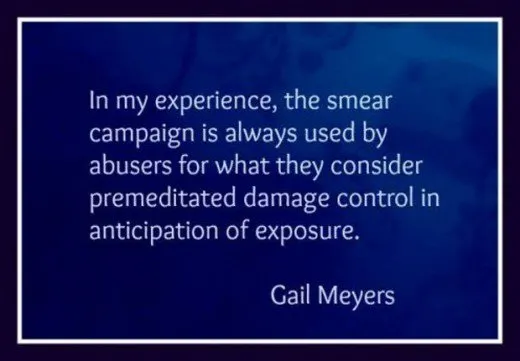
When toxic people feel threatened, they react with more manipulation and aggression. Basically, they start what is known as a smear campaign. They call their enablers to action through more lies, negativity, and exaggerations about their targets. They ramp up their alleged role of victim in their twisted game where they are, in fact, anything but victims. And their enablers naively jump to their defence and (in their minds) heroically rescue them from such horrible behaviour. Most of the time, enablers and flying monkeys don’t even attempt to hear anyone else’s side of the story. They flat out believe the nonsense they’re being fed. In my experience, some enablers will also return to scapegoating the narcissist’s target simply to bring an end to the ranting and raging. What they truly believe is anyone’s guess; their goal is simply to find a (usually temporary) reprieve from the toxic person’s thunderstorm. Overall, though, toxic people will pull out all the stops in an effort to maintain their control and position within their environment. Those false narratives are the very foundation of the protection of their egos. If they couldn’t triangulate and place blame on others, then they might ultimately be asked by their enablers to face accountability or, even worse, be forced to honestly evaluate themselves and engage in introspection. To a narcissist or other toxic individual, that would be a fate worse than death.

So if we’re the scapegoat and we recognize, based on the behaviour of others, that the narcissist/toxic person in our life has been frantically pumping those bellows and turning up the heat against us, even though we’re typically left in the dark as to what has been said, what can we do? Well, that varies by individual. One method that people find useful is to not JADE; that is, don’t Justify, Argue, Defend, or Explain. Yes, that’s a challenging task. No one wants to have lies floating around about them, and it’s human nature to want to JADE. But another more viable option is to simply live our lives and let our behaviour speak for itself. And in all honesty, silence speaks volumes, people. It truly does. There will always be enablers and flying monkeys. That’s just a fact of life. It lies with us to decide how much we will allow those dynamics to create negative personal impacts for us. Yet another option is to learn to let go of or distance ourselves from people who don’t see us as we truly are, but, rather, choose to believe the tales being spun about us by toxic people who are all about being in control and actively working to destroy relationships that they feel threatened by. Even though it’s easy to feel trapped within toxic systems, and we’ve often been trained to feel that we’re permanently stuck, helpless, and lacking any control over our own lives, we do have choices as to how we react to toxicity and dysfunction being aimed at us. We truly do have power. Remembering that fact and feeling empowered by it is half the battle.

Until next time,

Heather ~Natural Clarity Coaching~ naturalclaritycoaching.com na********************@***il.com Natural Clarity Coaching on Facebook, Instagram, LinkedIn, and Twitter