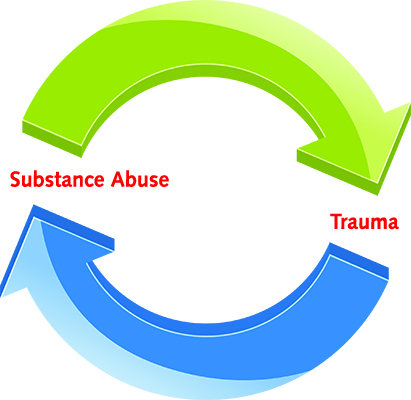
As I’ve written about in previous posts, narcissistic abuse can be emotional, physical, psychological, and/or verbal. Those who have experienced it may struggle with anxiety, depression, C-PTSD, self-esteem issues, dissociation, questioning reality, and other issues. Targets of narcissistic abuse may feel confused, ashamed, worthless, and to blame for situations that they didn’t cause. And this can occur within families, friendships, work environments, and romantic relationships.
Turning to substances or addictive behaviours may be viewed (consciously or unconsciously) as a means of coping with trauma and emotional pain, allowing for temporary relief from abuse and a false feeling of comfort and control. These may come in the form of alcohol, drugs, gambling, excessive shopping, eating disorders, risky sexual behaviours, or self-harm.
Seeking solace in substances or behaviours often becomes part of the cycle of abuse. Sometimes abusers may use their target’s addiction to manipulate and control them further in order to maintain power and dominance in the relationship. This can then add to the target’s feelings of helplessness and lack of control while deepening the abuse and addiction cycle.
Help is available, though, by having a professional create an approach for addressing both the trauma and addictive behaviours. CBT (cognitive behavioural therapy) and DBT (dialectical behavioural therapy) can be helpful to heal trauma, learn coping tools, and rebuild self-esteem and confidence. Online and in-person support groups (AA, etc.) are also invaluable resources.
As always, self-care is important in this process, as is establishing and maintaining boundaries and spending time with trusted others who are supportive of the healing process.
Remember that there is hope. Addiction is a common response to abuse and trauma because it provides a reprieve; but this is only temporary and addictions are unhealthy. So it’s important for those of us who are scapegoats or exposed to toxic people, to be aware of the potential for leaning on substances or addictive behaviours for solace in order to keep it and the intertwined cycle from happening. And if it has managed to happen, we need to seek support and assistance from professionals and trusted others so that we can eradicate it from our lives. We deserve to be healthy, abuse-free, and addiction-free.
Here are some book recommendations on the subject of abuse, trauma, and addictions: https://amzn.to/3UiE8CX
The answer to that question is: Yes, most narcissists will try to win you back if you leave them. However, they don’t do this for the same reasons that non-narcissists might. A major misstep is to believe that a narcissist thinks and feels like you do. In reality, they are coming from a completely different mindset; a mindset where winning someone back is about just that – winning. As always, their actions have absolutely nothing to do with you. Their actions are based on protecting their fragile egos by controlling everything and everyone around them.
Narcissists will use the tactic known as ‘love bombing’. Here, they engage in larger-than-life demonstrations of attention and affection in an attempt to influence someone. In the case of someone leaving them, they will love bomb to get that person back in order to feel better about themselves after being left and to regain control of the person in question. Many narcissists will actually win someone back just so that they can abandon them and then move on with their next victim.
Hoovering is a similar tactic used by narcissists. Just like the vacuum cleaner brand, Hoover, the disordered person will attempt to ‘hoover’/suck in the person who left them and bring them back into the abusive relationship. They may make promises that they will never cause any more hurt, that they will change, that everything will be different this time. This can all appear to be incredibly believable and sincere. Narcissists are generally very good actors and it’s not difficult to get drawn back into their web. The unfortunate part is that it’s all an act. Nothing will improve, and if it does, it won’t stay that way for long. It is all based on empty promises in an effort to manipulate, control and further abuse a partner, family member or friend, etc.
So, yes, narcissists will typically try to win you back if you leave them. But it’s not for reasons based on love, seeing the error in their ways, changing their negative behaviour, caring or anything positive. It’s all about winning, maintaining control, keeping their ‘supply’ (your attention for the purpose of their ego-stroking) intact, making sure that they maintain a certain image for the world around them, and ultimately avoiding ‘narcissistic injury’ (the experience of narcissists when they lose, are criticized or abandoned).
If you are thinking about, in the process of, or have recently left a narcissist, it’s helpful to keep in mind the information set out above. There’s no doubt that many victims of narcissists go back to them at least once after leaving. That’s a common and understandable occurrence. It doesn’t suggest any weakness or lack of intelligence; it’s related to being a human who wants to feel loved and to not feel that they have been wasting precious time in a particular relationship. Never feel ashamed or weak if you return to a narcissist and then find yourself in the same situation in not too long. Removing oneself from narcissistic abuse happens in stages as we become increasingly aware. And wanting to believe that someone you love could change for the better is not a negative mark on your character. Believing in the potential for change and love is a beautiful thing. Unfortunately, not everyone in our lives is up for the challenge. That’s their issue, not ours.
Armed with information about narcissistic tactics can help, though, to get us through the process of walking away when we feel it’s time and having the awareness of what would likely happen if we were to return. Knowledge is power. And as I mention often, asking ourselves honestly how this person truly makes us feel is an informative gauge to use in our decision-making with regard to the relationship. Do you feel loved or like a burden in their life? Are you treated with respect or disdain? Do you feel supported or sabotaged? Are your accomplishments/talents/skills encouraged and appreciated or is a never-ending list of alleged flaws being regularly highlighted? Do you feel comfortable in their presence or as though you’re walking on eggshells? Can you be yourself around them or do you need to filter or change who you are in order to be even slightly accepted and not constantly condescended to? Look at the entirety of your relationship and assess it overall with these types of questions. Honesty is integral. And listen to not only your mind but to your heart and soul. Tune out all external voices and opinions and tune in to yourself. The answers are always there when you’re ready to hear them.
Until next time,
Heather ~Natural Clarity Coaching~ www.naturalclaritycoaching.com na********************@***il.com Natural Clarity Coaching on Facebook, Instagram, Linkedin and Twitter
The realization of the fact that you’ve been experiencing narcissistic abuse is a double-edged sword. On the one hand, your eyes have been opened and you are now aware, which offers you the opportunity to make well-informed choices for yourself. On the other hand, this awareness often brings with it feelings of anger, regret, sadness, shame, isolation, confusion and so on. It basically takes your emotions on a whirlwind roller coaster ride.
My advice is to allow yourself to fully feel the array of emotions. They will be intense and sometimes overwhelming but you need to feel them in order to move on to processing them. Cry, scream, punch a pillow, etc. If you feel the need to talk with someone about your journey, do your best to turn to someone you know you can trust. This could be a family member, friend, support system such as Natural Clarity Coaching, or a counsellor/therapist. It’s not advisable to share your feelings with your abuser because that will simply open more doors for them to continue abusing you and playing mind games. Clarity is incredibly important at this time, so not allowing the narcissist to muddy the waters is beneficial. Yes, you’ll want to tell them that you’ve figured them out and that you’re incredibly hurt and upset. Just remember that these are people who lack empathy and compassion; they will never sincerely take accountability for their actions let alone offer up an apology or anything else that might make you feel less damaged. Plus, their goal is to continue to control you and carry on with your focus being on them, so keeping your feelings quiet from this person is usually the best policy. Find whatever trustworthy and helpful support systems you can while you’re moving through this part of the journey. Of course, if you prefer to do this solo, by all means, do. Whatever works for you. If you want to but can’t find anyone (or even if you can but could use more connections), online support groups can be incredibly helpful. There is something comforting and empowering about being able to read posts, write posts or comments if you want, involving people who have been or are currently in a similar place as you in a relationship with a narcissist (parent, partner, friend, etc.), It helps with gaining insight, feeling understood without having to explain yourself, seeing all of the parallels in the narcissists’ behaviours, and gaining strength in the knowledge that you didn’t cause this situation. In fact, many people begin to see that most narcissists seem to operate by the same play book! Sad but true.
The fork in your journey’s path
When you’re with the narcissist or by yourself in these early days of awareness, bring in calming and self-soothing practices such as deep breathing, mindfulness (being present in the moment without judgment), engaging in hobbies, getting out into nature, exercising, to name a few. Try to keep your mind from ruminating and replaying all of the negativity. That will just drag you into a potential state of depression and/or anxiety. And it’s okay to feel anger towards the narcissist but advisable to keep it under wraps. Now is the time to engage in self-care in order to keep yourself strong on all levels. Educate yourself on narcissism and how it has impacted you. Put some time into getting back in touch with yourself, your needs, your hopes and dreams. Focus on the future and what and who YOU want in your life from now on. You have arrived at a fork in your journey’s path and you have options from which to choose. Make plans for how you will deal with your new view of the relationship in question. Yes, there will no doubt be days that it all seems like too much and you might feel utter sadness and loss. You might even try to convince yourself that you’re wrong about this person and that you should give them a second chance. That’s perfectly ‘normal’.
As I’ve mentioned in previous posts, a great gauge for relationships is honestly taking a close look at how you truly feel when you’re around someone. Does the way they treat you make you feel good about yourself? Do you enjoy spending time with them? Do you feel cared for and important? Or does their behaviour make you feel unloved, unappreciated, and generally less-than? Is there often an air of condescension and disdain from this person when you interact with them? Do you regularly feel fearful in their presence, like you’re walking on eggshells, or worried that they could abandon you at any moment? Do you feel manipulated, controlled and/or under attack and as though you’re always making them upset and/or angry? Asking yourself these questions and answering them with 100 percent honesty can be a great reality check, especially if you have recently wondered if or decided that someone in your life is abusive towards you.
In summary, here are possible steps (in their simplest form) towards recovery:
Let the information about the narcissist and abuse sink in. Take all the time you need. It is typically shocking and life-altering when this revelation takes place.
Allow yourself to fully feel the emotions that come along with this realization, regardless of how difficult it may be. Do your best to not skip this step. It may seem too intense or as though you can just stuff everything down, but it doesn’t work that way. Feel them, because whether they make you angry, sad, confused, empty, or anything in between, you need to feel them. This is an integral part of the process.
While you are working on Step #2, do some research on narcissism and narcissistic abuse. You will likely discover that narcissists are disordered, dysfunctional people (most of whom have been hurt by other narcissists) who spend every waking moment trying to protect their fragile egos. If you happened to get caught up in their vortex, just know that their behaviour had nothing to do with you. You are not to blame. They are on auto-pilot in their lives, seeking to constantly fill a never-ending void (supply of attention from others) and to placate and dull their underlying feelings of weakness, neediness, low self-esteem and dysfunction. They typically demonstrate the same cycle of behaviours in most of their relationships. When you realize that, despite all the narcissist’s complaints and projections directed at you, their problems and issues are not your fault, you aren’t defective or to blame for everything that goes wrong in their life, you are deserving of kindness, respect and caring, then you will learn to expect so much more for yourself and not be willing to accept sub-par treatment.
Begin to process your emotions. You’ve taken the opportunity to feel them, and now it’s time to look at them from a more practical standpoint. Sometimes it helps to do this with a therapist or within a safe support system. But if you feel that you want to start out on your own with it, give it a try. Don’t expect this stage to be a quick one, though. The gamut of emotions has likely been run throughout your relationship with this person so there will be a lot to sort through and try to make sense of. You may even question everything you felt or believed in the past. You may need to revisit many different memories and experiences in order to look at them from a new point of view. That’s okay. In time, your mind and heart will put it all together in such a way that you can move forward more easily. For now, show yourself patience, understanding and love. You’ve been through a very difficult experience and you need to feel compassion for yourself. Whatever you do, don’t skip this step.(#4). When we leave emotions and challenging experiences unprocessed, they don’t just go away. They will interfere with our everyday lives and new relationships and friendships, sometimes in ways that the connection to your past experiences isn’t even on the radar. They will pop up at times when you least expect them, sometimes in the oddest of ways. But have no doubt, they’ll be there until you deal with them once and for all. Imagery can help here. A good exercise is to face the memories/thoughts/feelings head-on. Picture each of them as being on a sheet of paper. Be honest with yourself about how you felt at that particular time and how you feel now. You could even write everything down and then burn the papers later, or work through it out loud with a trusted support person. And then, when you feel ready, imagine placing that sheet of ‘memory’ paper into a file folder marked ‘Closed’, which then goes into a filing cabinet or even a bonfire. Whatever works for you, give it a try. EMDR and Brainspotting are also very helpful for processing difficult emotions and thoughts. Find a qualified practitioner if this interests you.
Start making plans for your future that include your hopes and dreams. It’s finally your time to fully take care of yourself and begin to look forward to what lies ahead on your journey. And now that your awareness of narcissism has grown, you will be much less likely to fall prey to a narcissist in the future.