Within a dysfunctional, narcissistic family, when we think about breaking ties with one or both of our parents, or maybe our entire family of origin, many questions tend to arise. Will I go low contact or no contact? How will I make it happen? Will there be backlash? Will anyone care that I’m cutting down on communication with them or cutting them off altogether? How will I get along without them? And so the questions will go.
For me, personally, I realized that I had almost entirely lost any semblance of the self I thought I knew and was also truly at a point where I thought I might have a breakdown. Other people in my life needed me to be whole and there for them, though. Regardless of the fact that, at that time, I didn’t really care about myself, I couldn’t just give up. So, although my life had been spent with the imposed requirement of putting everyone else’s needs and feelings before (or entirely to the exclusion of) my own, I finally realized that I couldn’t pour from an empty cup. I also couldn’t continue on in fight, flight, or fawn mode because it was taking its toll on my body and mind. And I instinctively knew that my first step to self-care needed to be removing myself from environments of toxicity. And that’s what I did. I moved several hours away and never looked back. While I did start out with more of a hopeful, low contact mindset, that eventually moved to no contact because I learned to have self-respect and boundaries, and then had grown less and less tolerant of the abusive behaviour that I had known for so long. Yes, that abusive behaviour continued after I moved away. It continues to this day, but in the form of indirect messages through unsuspecting others. But I’ve learned to see it for what it is and just allow it to slide off me. And, overall, that type of behaviour only serves to reinforce my decision to walk away in the first place.
Let me be clear that none of this was easy…but, for me, it was necessary, and so I moved forward and continued to do so no matter what obstacles stood before me. It took time to work my way through it. There were some incredibly challenging moments on many fronts (emotional, financial, relationships (lost or damaged), C-PTSD, anxiety, depression, etc.). But my intuition — together with a strong unwillingness to ever again experience the type of feelings that go along with being constantly scapegoated and abused — told me to keep putting one foot in front of the other. Eventually, genuine peace came into the life I had built, and I started discovering the real ME for the first time ever. I will never let go of that identity or peace for myself or the people who are directly in my life, and if that means remaining no contact with certain individuals, I can easily accept that. Honestly, there isn’t any other option in my mind. I suppose the best way to explain it is that as you take the steps to save yourself (and possibly others, such as children) and to create a better existence, everything else gradually falls into place. It’s a journey well worth taking, in my opinion.
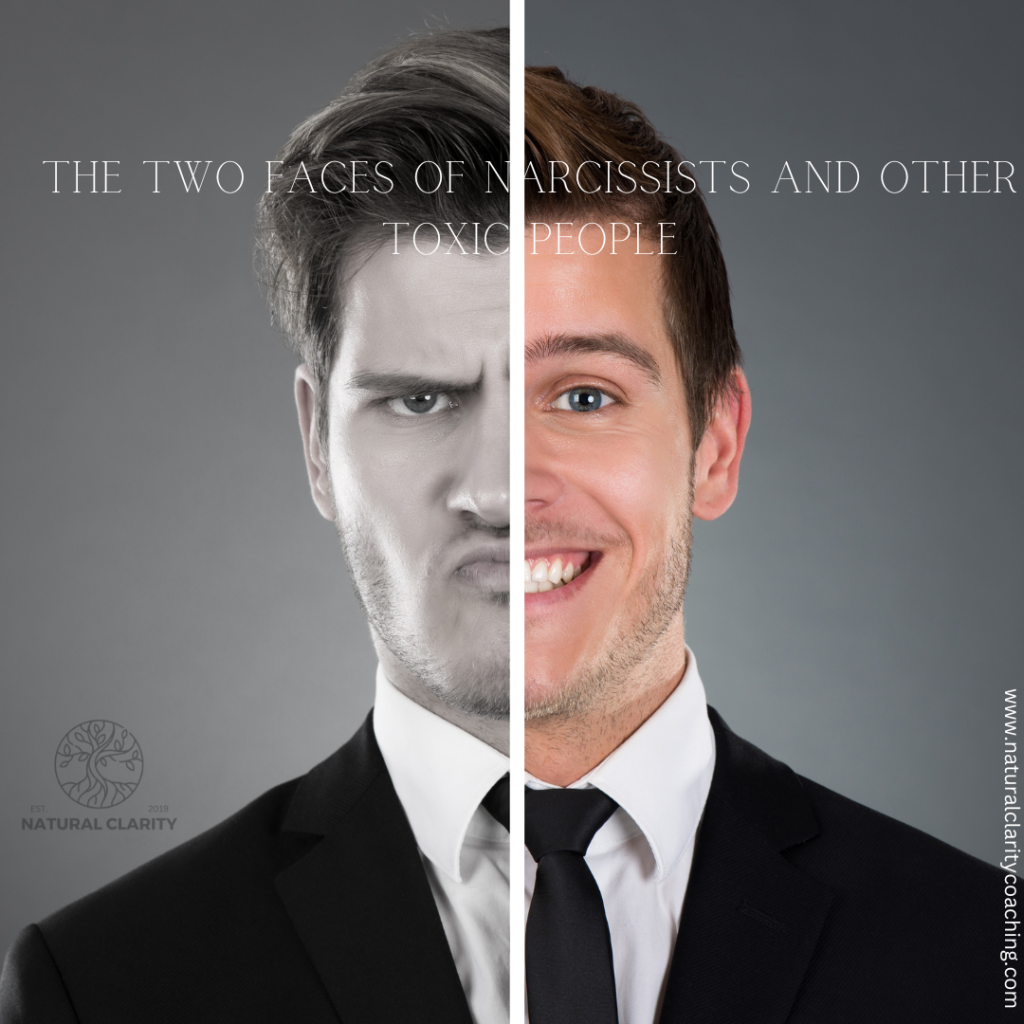
If we happen to be a family scapegoat or in a relationship with an intimate partner or friend who exhibits narcissistic traits, we will likely have seen the two different faces that they sometimes wear.
In private, these individuals can be abusive, hostile, angry, jealous, unpleasant people to be around. They don’t try to appear otherwise, in most cases. They treat us poorly and their attitudes towards us are written all over their faces and in their body language.
But, often, when we are in public with these same individuals, their entire demeanour, facial expressions, and body language will suddenly change for the better. If other people are in the vicinity, these individuals — who couldn’t smile at us in private to save their lives — are now smiling, sweet, and pleasant to everyone, including we scapegoats. They appear to be the wonderful, loving parent, partner, friend, and so on. But the key word here is ‘appear’.
The public display of niceness is an act. It’s all about appearances and putting on a show so that outsiders are kept in the dark about who these individuals are in their personal relationships. A narcissistic parent wouldn’t want the world to know that they regularly tell their scapegoat daughter, for example, that she’s unattractive, unintelligent, and unlikeable. The intimate partner tries to avoid outsiders knowing that, for instance, although they look attentive, gentle, and helpful with their children, they do absolutely nothing to pull their weight in any way in private. Toxic friends will appear to be bonded to scapegoated friends when they’re out, but smear campaigns may be building behind the scenes.
The ‘nice’ facade can be unsettling and confusing for scapegoats. “This person just screamed at me in the car on the way to the concert, but now they’re behaving as though we’re a loving family while we’re out around other people”. That might be the type of observation we make, and it can be disorienting. And then when we’re back in private with them, they revert to their toxic selves once again. It can be a roller coaster ride.
But once we recognize that it’s all an act, it gets easier to ride out the ups and downs. Narcissists typically want the world to see them in a bright and shiny way. They want respect, adulation, compliments, and other great things from people. Those things feed their fragile egos. In private, with their scapegoat(s) and enablers, they can pull off the mask and behave in whatever way they want. They have created the perfect environment in which to abuse people and get away with it so why would they bother to make any effort to be nice in that space? Plus, if they behave one way in private, and another way in public, people would be less likely to believe a scapegoat who tries to get help or vent. “But your ‘fill-in-the-blank’ is so kind and nice! How could you say that about them? What’s wrong with you?”. Not everyone would react this way, but many would because they are unaware of the dynamics at play.
In the end, we need to remember that there are two faces to most narcissistically-inclined individuals. And we can’t be fooled into thinking that the ‘nice’ act will continue in private or that these people have suddenly and permanently changed for the better. That’s a very rare occurrence. It’s all a show to keep others from seeing the truth.
As with most things, there will be toxic and/or narcissistic individuals who don’t fit into the typical mold of behaviours. They may be blatantly unpleasant with everyone in their surroundings and couldn’t care less what people think of them (overt narcissists). But it seems that many tend to be covert with their actions. They want to ensure that an impressive persona is created for outsiders. Appearances are everything to them because their egos depend on it.
The bottom line is that awareness is key with these behaviours. Scapegoats can’t continually ride out those emotions that can go along with behaviour changes in narcissists and others. That would be exhausting. The best thing to do is see things as they are. Otherwise, we would always be hoping and then being let down and hurt over and over again, which is emotionally draining. Awareness, self-care, self-love, and growth mindset are beneficial.
Narcissists often have a strong need for admiration, validation, and a sense of superiority. They may engage in behaviors that make them feel better about themselves and maintain a grandiose self-image. Scapegoating is one such behavior where a person is unjustly blamed and targeted for problems or shortcomings within a group or relationship.
In the context of narcissism, scapegoating can serve the narcissist’s need for superiority by deflecting blame and maintaining their self-esteem. By designating someone as a scapegoat, narcissists may feel a temporary boost in their own self-worth, as they can attribute problems or failures to the targeted individual rather than acknowledging their own shortcomings.
It’s important to note that not all narcissists engage in scapegoating, and individuals with narcissistic traits may express their need for superiority in various ways. Scapegoating is just one potential manifestation of this behavior. Additionally, narcissistic tendencies exist on a spectrum, and individuals may exhibit different degrees of narcissistic traits.
Understanding and dealing with narcissistic behavior can be challenging, and it’s often recommended to seek professional help if you’re dealing with a relationship involving narcissistic dynamics.
Question: Where’s the justice when we’ve been abused by a narcissist or other toxic individual? ⚖️
Well, let’s give this some thought. Overall, toxic and narcissistic people won’t accept accountability or apologize for anything…ever. That’s just how they roll. And if you pushed them to admit to their abusive behaviour or to issue an apology, there’s a fairly high chance that they’d gaslight you and toss out even more emotional and other abuse. And unless they’ve broken the law, we (unfortunately) can’t have them arrested for simply being who they are.
Here’s the thing: we need to give ourselves justice. How do we do that? Through learning and empowering ourselves about toxic behaviours and how we were impacted, and by healing ourselves, growing through self-care and personal development, and then thriving in our lives. We let go of thinking about our abuser and the what’s and why’s of their actions. We find ourselves. We find peace. We find purpose and fulfillment. That’s our justice. We prioritize our healing and we move forward on our journey.
Learn, Heal, Grow, Thrive
And if we need a little extra notion of justice, consider what it’s like to be a toxic individual. At some point, they, too have been damaged and they’ve emerged from it angry, messed up, and lost. By choice, they aren’t working on themselves, and their miserable lives continue that way as a result. (Some) hurt people hurt people. Not making excuses for abuse or toxic people in any way. It’s just reality. They’re broken people.
We need to remember that we have the option of giving ourselves justice through learning, healing, growing, and thriving. Talk about a superpower!
Dealing with the aftermath of a toxic person can be challenging, but it’s essential to focus on our own well-being and cultivate a positive mindset. Here are some strategies to help us avoid spending time hating a toxic person and promote positivity instead:
Acceptance and Forgiveness:
Acknowledge the situation and accept that it happened. Acceptance doesn’t mean approval, but it allows us to move forward.
Work on forgiving the person. Forgiveness is not about condoning their actions but about freeing ourselves from the negative emotions associated with the situation.
Set Boundaries:
Establish clear boundaries to protect ourselves from further harm. This might involve limiting or cutting off contact with the toxic person.
Prioritize our mental and emotional well-being by creating space between ourselves and the source of toxicity.
Focus on Self-Care:
Invest time and energy in self-care activities that bring us joy and relaxation. This can include hobbies, exercise, mindfulness, or spending time with supportive friends and family.
Take care of our physical health by getting enough sleep, eating well, and engaging in activities that promote overall well-being.
Shift Our Perspective:
Try to see the situation from a different perspective. Consider the toxic person’s actions as a reflection of their issues rather than a reflection of our worth.
Focus on the lessons learned from the experience, and use it as an opportunity for personal growth.
Surround Ourselves with Positivity:
Surround ourselves with positive influences, whether it’s supportive friends, uplifting activities, or inspirational content. ❤️ This can help counterbalance the negativity from the toxic person.
Engage in activities that bring us joy and create a positive environment for ourselves.
Practice Gratitude:
Cultivate a gratitude mindset by focusing on the positive aspects of our lives. Regularly acknowledge and appreciate the good things, no matter how small they may seem. ⭐️
Keeping a gratitude journal can be a helpful daily practice to shift our focus toward the positive.
Seek Professional Support:
If the impact of the toxic relationship is severe, consider seeking the help of a therapist or counselor. They can provide guidance, support, and tools to help us cope and move forward.
Learn and Grow:
Use the experience as an opportunity for personal growth.🌻Reflect on the lessons learned and how we can become more resilient and better equipped to handle challenging situations in the future.
Remember, letting go of hate and negativity is a process that takes time, but making a conscious effort to focus on positivity and self-improvement can lead to a more fulfilling and happy life.
Rebuilding trust after narcissistic abuse can be a challenging and gradual process. Here are some steps we can consider taking to rebuild trust in ourselves and others:
Understand the Dynamics of Narcissistic Abuse: Educate yourself about narcissistic abuse to gain a deeper understanding of what you’ve experienced. Knowledge can empower you to recognize and address the patterns of manipulation and control.
Seek Professional Support: Consider seeking therapy or counseling with a mental health professional experienced in trauma and abuse. A therapist can help us navigate our emotions, process the trauma, and develop coping strategies.
Establish Healthy Boundaries: Learn to set and enforce healthy boundaries. Identify what is acceptable and unacceptable behavior in our relationships, and communicate these boundaries assertively.
Practice Self-Compassion ❤️: Be patient and gentle with ourselves. Healing takes time, and it’s essential to acknowledge our progress and give ourselves credit for overcoming challenges.
Cultivate Self-Awareness: Develop a deep understanding of ourselves, our needs, and our values. This self-awareness will help us make healthier choices in relationships and identify red flags early on.
Build a Support System: Surround ourselves with supportive friends and family who understand our journey and can offer encouragement. A strong support system can provide validation and help rebuild our sense of trust in others.
Set Realistic Expectations: Understand that trust-building is a gradual process. It’s okay to take small steps and set realistic expectations for ourselves. Celebrate the victories, no matter how small, along the way.
Engage in Activities We Enjoy: Reconnect with activities and hobbies that bring us joy. Engaging in positive experiences can contribute to our overall well-being and help us rebuild a sense of trust in the world.
Explore Mindfulness and Relaxation Techniques: Practices such as mindfulness, meditation, and deep breathing can help us manage anxiety and stress. These techniques can also enhance our ability to stay present and focused on the positive aspects of our lives.
Consider Professional Development: If applicable, consider career or personal development opportunities to boost self-esteem and confidence. Feeling accomplished in other areas of our life can positively impact our ability to trust ourselves and others.
Remember that healing from narcissistic abuse is a unique and individual process. If we find the journey particularly challenging, seeking professional help is crucial. A therapist can provide guidance, support, and additional strategies tailored to our specific situation. ⭐️
Experiencing narcissistic abuse, especially on a long-term basis, can have profound and lasting cognitive effects. It’s important to note that the impact of abuse can vary from person to person, and not everyone will experience the same effects. Here are some common cognitive effects associated with narcissistic abuse:
Low Self-Esteem: Narcissistic abuse often involves demeaning and belittling behaviors, which can erode a person’s self-worth and confidence. Victims may internalize the negative messages and develop low self-esteem.
Gaslighting: Narcissists frequently use gaslighting techniques to manipulate and control their victims. Gaslighting involves distorting or denying the truth, causing the victim to doubt their own perceptions, memories, and sanity. This can lead to confusion and self-doubt.
Anxiety and Depression: Long-term exposure to narcissistic abuse can contribute to the development of anxiety and depression. The constant stress, fear, and uncertainty in an abusive relationship can take a toll on mental health.
Cognitive Dissonance: Victims of narcissistic abuse may experience cognitive dissonance, a psychological phenomenon where a person holds conflicting beliefs or attitudes. This can occur when the victim is simultaneously aware of the abusive behavior but struggles to reconcile it with the manipulative charm or kindness displayed by the narcissist.
Hypervigilance: Living with a narcissist can create an environment of unpredictability and fear. As a result, survivors may develop hypervigilance—a heightened state of awareness and sensitivity to potential threats. This constant state of alertness can be mentally exhausting.
Difficulty Trusting Others: Betrayal and manipulation by a narcissist can make it challenging for survivors to trust others. They may fear being deceived or hurt again, leading to difficulties forming and maintaining healthy relationships.
Sense of Guilt or Shame: Narcissists often blame their victims for the problems in the relationship, even when the responsibility lies with the abuser. This can lead to feelings of guilt and shame in the survivor, perpetuating a cycle of self-blame.
Impaired Decision-Making: The constant manipulation and control tactics employed by narcissists can undermine a person’s ability to make independent decisions. Survivors may second-guess themselves and struggle with decision-making.
Isolation: Narcissists may isolate their victims from friends and family as a means of maintaining control. This isolation can contribute to feelings of loneliness, further impacting the person’s mental well-being.
Post-Traumatic Stress Disorder (PTSD): In severe cases, prolonged exposure to narcissistic abuse may lead to symptoms of post-traumatic stress disorder, such as intrusive memories, flashbacks, and heightened arousal.
It’s important for individuals who have experienced narcissistic abuse to seek support from mental health professionals, friends, or support groups. Therapy can be a crucial step in healing and rebuilding cognitive and emotional well-being.
Experiencing grief after the death of a disordered or enabling parent can be a complex and challenging process. It’s important to recognize that everyone’s experience with grief is unique, and there is no right or wrong way to feel. Here are some thoughts and suggestions that might help us, particularly as scapegoats, to navigate this difficult time:
Allow Yourself to Feel: Grieving is a natural and individual process. Allow yourself to feel a range of emotions, including sadness, anger, relief, confusion, or even a lack of emotion. It’s okay to experience a mix of feelings.
Seek Support: Consider reaching out to friends, family, or a therapist who can provide a supportive and non-judgmental space for you to express your emotions. Grieving can be a solitary process, but having a support system can make a significant difference.
Set Boundaries: If there are family members or others who may not understand your complex relationship with the deceased, it’s okay to set boundaries. You don’t owe anyone a detailed explanation of your emotions, and it’s crucial to prioritize your well-being during this time.
Journaling: Writing down your thoughts and feelings in a journal can be a therapeutic way to process your grief. It can also help you gain clarity and insight into your emotions.
Self-Care: Take care of yourself physically and emotionally. Grieving can be exhausting, so ensure you get enough sleep, eat well, and engage in activities that bring you comfort and joy.
Therapy or Support Groups: If the relationship with your parent was particularly challenging due to narcissism, enabling, or other issues, seeking therapy or joining a support group can be beneficial. A mental health professional can help you navigate the complexities of your emotions and provide guidance.
Acknowledge Mixed Emotions: Grieving a narcissistic or estranged parent can be complicated because of the conflicting emotions involved. You might feel relief or freedom along with grief. Acknowledge these mixed emotions without judgment.
Forgiveness (If Possible): Forgiveness is a personal process and not something everyone can or should pursue. However, some individuals find a sense of peace in forgiving, not for the benefit of the deceased but for their own healing.
Remember that healing is an individual and gradual process, and it’s okay if it takes time. Be patient with yourself and, if needed, seek professional support to help you navigate the emotional complexities of grieving a narcissistic or enabling parent.
I don’t often write from a strictly personal level but I thought this experience might resonate with other scapegoats.
My narcissistic parent – despite constantly pressuring me to attain high levels of achievement – has told me, from the earliest days I can remember, that I’m ‘average’. Average (sometimes below average) at everything – academics, music, athletics, social skills, personality, appearance, and so on. And I was constantly reminded that while high achievement was required by them, I was incapable of achieving it. Impossible situation. You get the picture. And I was informed of this at every opportunity. The message was that I was never enough, that I was always falling short. And so, from the time I was a young child, I believed the negativity and biased things I was told about myself. I mean, as children, we tend to believe our parents without question. They’re our everything, and we think that they’ll keep us safe and look out for our best interests. I was no different in that regard.
Negativity Bias
I always hoped that my parent might show pride or give me a compliment if I just kept working away as much as possible, existing under constant pressure. I wanted to make them proud. I wanted to avoid their disappointment and negative comments. But it never happened, no matter what I did. If I received an ‘A’ on a school project, they wanted to know why it wasn’t an ‘A+’. If I received an ‘A+’ on an assignment, then they assumed every student must have received high marks because it was too easy. Or if I was practicing the piano, one wrong note was all I received feedback on from my parent while the many accurate notes were completely ignored. I typically felt as though I was failing at everything I attempted. It seemed as though I was never good enough and never would be. And, ironically, yes, my golden child sibling was often an underachiever and yet received accolades from our narc parent at every turn. That continues to this day.
Narcissistic family depiction
Looking back, at different times over the years, at report cards, music conservatory records, sports medals, memories of great friendships, compliments from trusted others, and who I knew or felt myself to be, I often questioned the significant differences between my parent’s perspective of me and my achievements and the voices of those outside our immediate family. And yet I always deferred to the negative portrayal simply because this was my parent and I thought they knew me best. In fact, I was often told that they knew me better than I knew myself. Their negative voice and perspective eventually became cemented in my mind and coloured most of my daily life. It did a lot of damage, to say the least. And, as an adult, it took a lot of time and effort to undo the worst of it once I realized the truth about my family. Now I look at the past through different eyes and give myself credit for my achievements, especially in the face of the negativity and never-ending stress that existed.
Fast-forward to this week. Narcs like to come out of the woodwork during special occasions. Although I’m no-contact with this individual, they are determined to get negative messaging to me and tend to do that through family members. So, the long and the short of it is that my ‘parent’ (using the term loosely) conveyed to a family member a comment that made it unquestionably clear that their unfounded belief about my ‘average-ness’ or ‘below average-ness’ has not changed in the slightest, regardless of my actual accomplishments and who I actually am as a person. They continue to launch smear campaigns and take aim at me, even after years of estrangement.
And that’s okay. Why? Because it’s their issue, not mine. This person branded me as a scapegoat as soon as I came into the world. They’ve felt threatened by my very existence because they’re always on high alert for protecting and bolstering their fragile ego. They needed someone to take all the blame in the family, and I was the chosen one. And that behaviour has continued throughout my life. I’ve been the family scapegoat since day one. My enabling parent told me several years ago that I had been the ‘problem’ in our family my entire life because I wouldn’t go along with the dynamics of their toxic spouse. That’s the scapegoat role in a nutshell. Even though I’ve kept myself protected and out of their lives for many years, they still need to keep me (in their mind) in that role in order to maintain the balance of the dysfunctional family dynamics. This person’s attitude towards me will never change, nor will my enabling parent ever see me in any way but what is dictated by the head narc because, otherwise, their life would be complete misery. I know all of that, I accept it, and it is what it is.
So be it. It literally has nothing to do with me. And for all of you who are scapegoats, how you are perceived by dysfunctional family members and other toxic individuals or enablers is not rooted in reality. It’s based in who they need to see you as – who you need to be in their minds – in order to ensure that your scapegoat role continues. Being able to point fingers and place blame on you is the key for them to avoid the consequences of their own bad behaviour. Even if you’re not in their lives and they know nothing about your life, they will continue to target you. They need you. But the truth is, you don’t need them. Someone once asked me, “If they weren’t your parent, would you choose that person as a friend?”, and I couldn’t honestly say that I would. I prefer non-toxic friends.
Going into this new year, let’s all try to show ourselves compassion, acceptance, patience, and love. Positive self-perception has the power to override even the worst of comments and attitudes from narcissistically inclined people. We get this one life to live and we might as well make it a great one. Some people aren’t conducive to that goal, and they never will be. In the end, as adults, we have the ultimate choice in who goes along with us on our life’s journey. Choose wisely, my friends. And it also helps to keep in mind that low expectations can go both ways. We may have a parent who scapegoats us and, in my specific case, places us in the realm of ‘below average’ or some other unjustified space, but the most realistic response to those attitudes is to hold low expectations of that parent who scapegoats us. They are emotionally immature people who engage in smear campaigns against their own scapegoated children, regardless of their age or any other factors, and have never been supportive, shown authentic pride, or expressed genuine love for us. Why expect more? Let’s all be our own biggest fan and negate the need to seek approval from others, particularly narcissists.
I hope that this post helps someone in some way. ❤️